Skip to content
Skip to content

SP-4 Gongsun (公孫) — Grandfather-Grandson

SP-4
Gongsun
公孫
Grandfather-Grandson · Grandfather Grandson
SP-4 Gongsun — Grandfather-Grandson
Ponto Luo de ConexãoPonto Confluente do Chong Mai (Vaso Penetrante)Ponto Luo do canal do BaçoSafeMembro Inferior
Depth
00.5–0.7 cun3.0
Perpendicular insertion
Precautions
No standard precaution.
Location (classical)
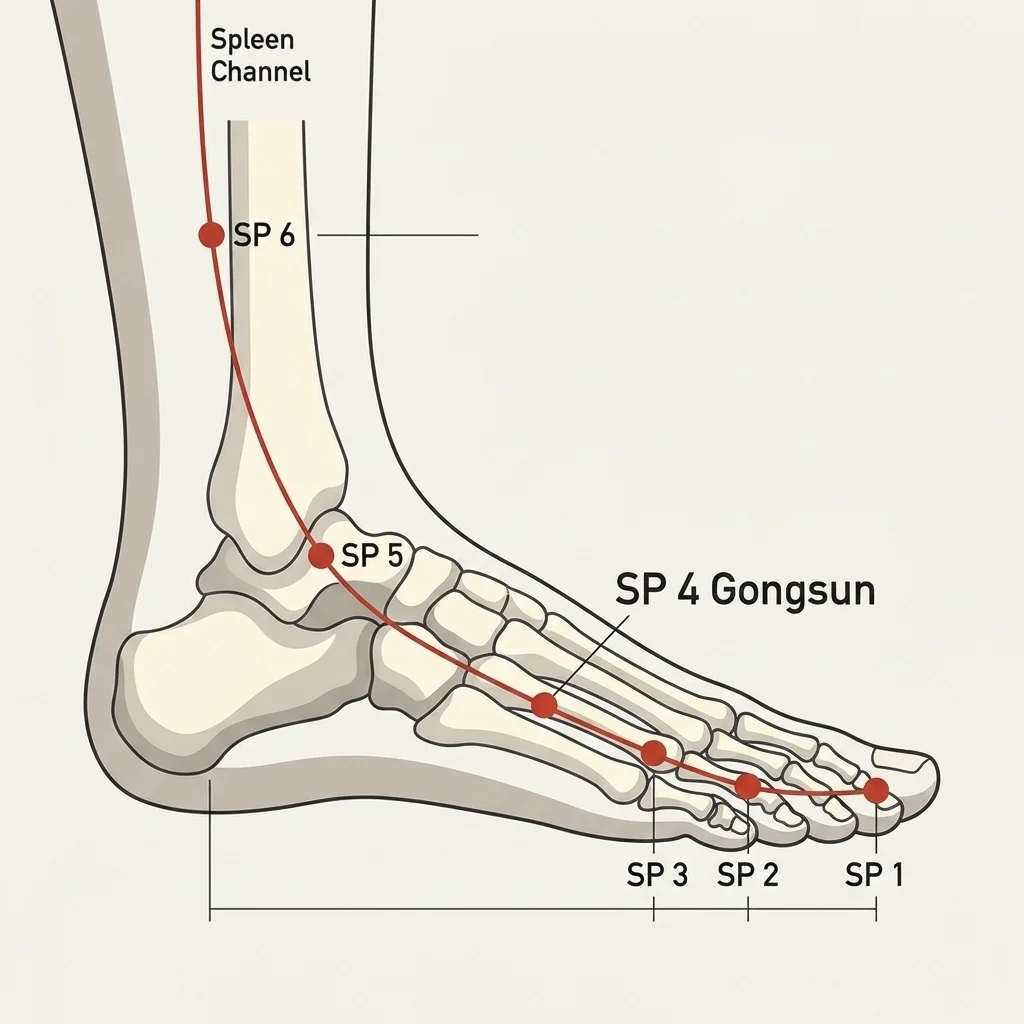
On the medial aspect of the foot, anteroinferior to the base of the first metatarsal, at the transition between the medial and plantar skin.
How to find it (practical)
Seated with the feet supported or supine, locate the point in the region anteroinferior to the base of the first metatarsal bone, 1 cun posterior to Tai Bai (SP-3).
Anatomy
Abductor hallucis muscle. Innervated by the saphenous nerve and the medial plantar nerve.
Needling
Perpendicular insertion 0.5–0.7 cun.
Etymology
Gong (公), nobleman; Sun (孙), grandson. The site where the branching of the collateral begins.
CLASSICAL SOURCELing Shu

Clinical Relations

Point Pairs
Classical Combinations
PC-6 NeiguanConfluent pair (Chong Mai)
Chest and heart disorders, stomach pain, gynecological conditions
Adjacent Points on the Meridian

SP 4 in research

How many Library studies cite this point, since when, and with which designs and verdicts.

Studies
6Library studies cite SP 4
By year
20142024
Verdict
  • Strong1
  • Moderate5
Study designs
  • Meta-analysis2
  • Systematic Review1
  • RCT1
  • Narrative Review1
  • Other designs1
Classical source
Ling Shu
Depth
0.5–0.7 cunPerpendicular

Each study counts once, under the most specific design it states. The verdict is the Library’s word for the strength of each study’s evidence.

See the numbers: SP 4 in research
YearStudies
20141
20202
20232
20241

Often appears with

Points the Library studies cite together with SP 4. It shows research practice, not a prescription.

  1. ST 366 studies in common
  2. PC 64 studies in common
  3. LR 34 studies in common
  4. CV 124 studies in common
  5. ST 253 studies in common
  6. SP 63 studies in common
  7. ST 372 studies in common
  8. KI 32 studies in common

Each filled mark stands for 5 studies; an open mark, for 1 to 4.

Related Articles

6

Translation and clinical dataProf. Dr. Hong Jin Pai — Meridians: Theory and Clinical Practice, 4th edition. CEIMEC · São Paulo.

CodingWHO Standard Acupuncture Point Locations (2008) for classical and extra points.