Skip to content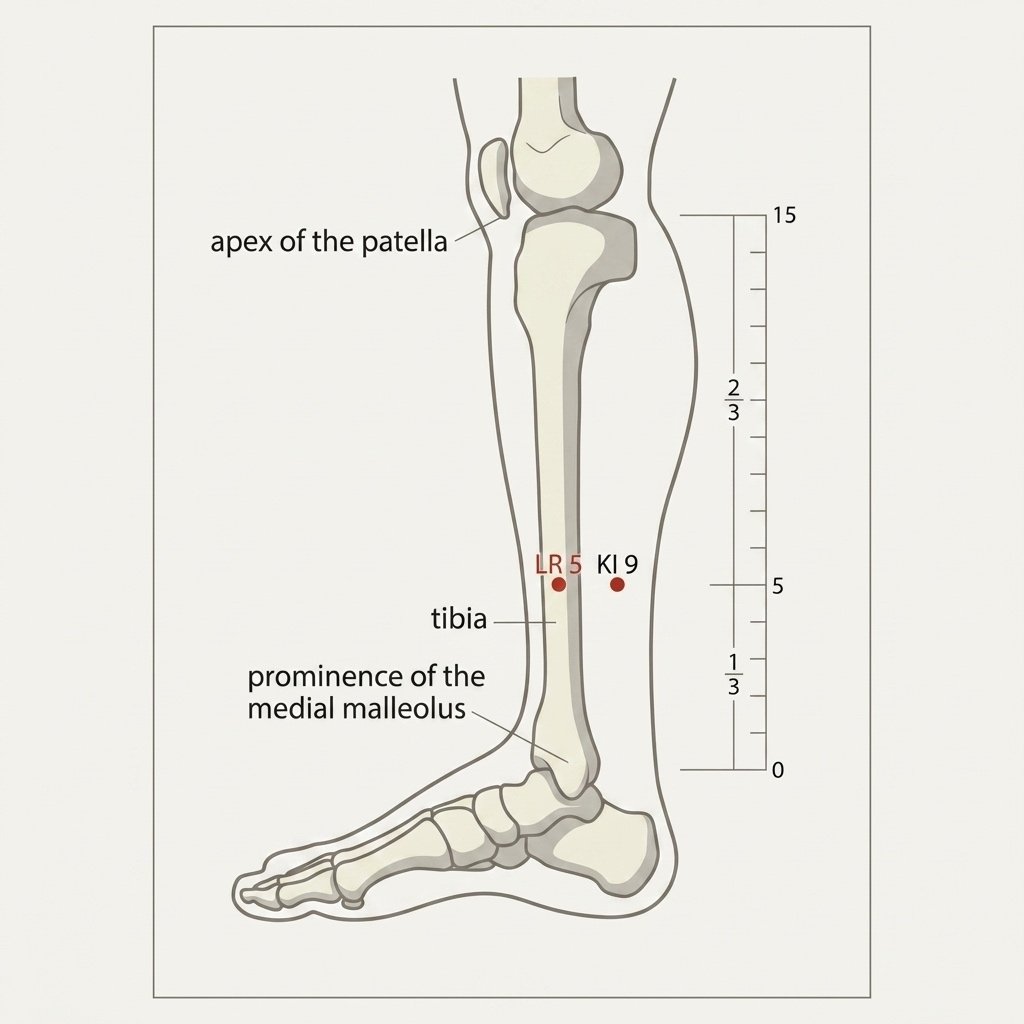
LR-5 Ligou (蠡溝) — Woodworm Canal
LR-5
Ligou
蠡溝
Woodworm Canal

Ponto Luo de ConexãoPonto Luo do canal do FígadoPonto distal genitalSafeMembro Inferior
Depth
00.5–0.8 cun3.0
Transverse insertion
Precautions
The bone lies directly beneath; do not needle perpendicularly.
Location (classical)
On the anteromedial aspect of the leg, at the center of the medial surface of the tibia, 5 B-cun above the prominence of the medial malleolus.
How to find it (practical)
From the prominence of the medial malleolus, measure 5 B-cun toward the knee. At that level, locate the center of the medial surface of the tibia.
Anatomy
Directly over the medial surface of the tibia. Innervated by the saphenous nerve.
Needling
Transverse (subcutaneous) insertion, 0.5 to 0.8 cun.
Etymology
Li (蠡), orifice; Gou (沟), depression. The point is located in a depression on the medial margin of the tibia, resembling an orifice.
CLASSICAL SOURCELing Shu
Clinical Relations
Point Pairs
Yuan-LuoGB-40 Qiuxu
Adjacent Points on the Meridian
LR 5 in research
How many Library studies cite this point, since when, and with which designs and verdicts.
- Studies
- 1Library study cites LR 5
- By year
- 2021
- Verdict
- Moderate1
- Study designs
- Other designs1
- Classical source
- Ling Shu
- Depth
- 0.5–0.8 cunTransverse
Each study counts once, under the most specific design it states. The verdict is the Library’s word for the strength of each study’s evidence.
See the numbers: LR 5 in research
| Year | Studies |
|---|---|
| 2021 | 1 |
Often appears with
Points the Library studies cite together with LR 5. It shows research practice, not a prescription.
- ST 361 study in common
- SI 31 study in common
- BL 401 study in common
- BL 601 study in common
- BL 621 study in common
- KI 71 study in common
- GB 341 study in common
- GB 411 study in common
Each filled mark stands for 5 studies; an open mark, for 1 to 4.