TE-1 Guanchong (關衝) — Passage Hub
On the ulnar side of the ring finger, a small distance from the corner of the nail. Specifically, 0.1 cun from the ulnar corner of the nail.
With the palmar surface facing down, locate the point at the intersection of the lines passing through the ulnar border and the base of the nail of the ring finger.
Skin, subcutaneous tissue, dorsal digital nerve and vein, dorsal branches of the proper palmar digital branches of the ulnar nerve and proper palmar digital arteries, and the fourth distal phalanx (distal phalanx of the ring finger).
Transverse (subcutaneous) insertion, 0.1 cun, and pricking to bleed.
Medical application & myofascial correlation
Clinical synthesis
Point used in emergency treatments. Indicated to treat fever, stroke, heatstroke, and coma or loss of consciousness, by promoting bleeding. It is used to treat numbness in the tips of the fingers. Shao Shang (LU-11), Shang Yang (LI-1), Zhong Chong (PC-9), Guan Chong (TE-1), Shao Chong (HT-9), Shao Ze (SI-1) on both hands are called the Twelve Jing (Well) Points. They are used to awaken the patient from unconsciousness, sedate the meridians and collaterals, and eliminate perverse heat. Used to treat coma, loss of consciousness, numbness in the tips of the fingers, and fever. Clinically, each one has its own characteristics. Shao Shang (LU-11) is used to improve Qi flow in the Fei (lung) and resolve Biao syndrome. Relieve sore throat and eliminate heat. Shang Yang (LI-1) is used to eliminate accumulated heat in the Yang Ming, relieve sore throat, and exterior syndrome. Zhong Chong (PC-9) is used to eliminate heat in the Xin (heart), to tranquilize the mind and eliminate heat stagnation in the Xin Bao (Pericardium) and to awaken the patient from the state of unconsciousness (its main function). Guan Chong (TE-1) is used to eliminate heat in the Upper Jiao and heat stagnation in the Hand Shao Yang Meridian. It is effective in treating diseases of the ears and eyes. Shao Chong (HT-9) is used to eliminate and remove fire from the Xin (heart), tranquilize the mind, eliminate stagnant heat, and stimulate the Qi of the Xin (heart). Shao Ze (SI-1) is used to eliminate heat from the Xin (heart), improve irritability, and promote lactation.
Clinical practice indications
- 01Acute tonsillitis
- 02High fever
- 03Syncope
- 04Acute conjunctivitis
- 05Sudden deafness
Presenting symptoms & complaints
Classical tradition, channel actions & source
Classical therapeutic actions
- Clears Heat of the Upper Jiao
- Benefits the ears and tongue
- Restores consciousness
Traditional indications (TCM)
Functional classification
Character etymology
Guan (关), strategy; Chong (冲), gushing. Qi exits this point rapidly as if gushing. Strategic departure point of Qi for the three Yang meridians of the Hand.
Layered tissue anatomy & needle biomechanics at TE 1
Cross-sectional technical schematic of transverse insertion (~15°) (0.1 cun): superficial connective collagen coupling, intramuscular myofascial transduction, and deep neurovascular protection.
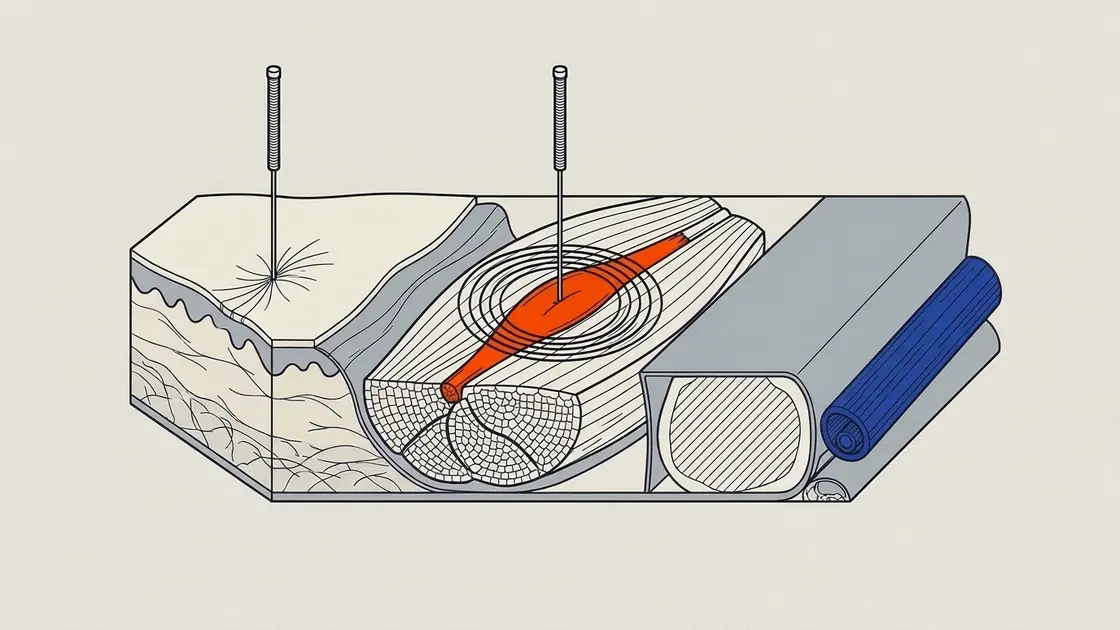
Dermal & fascial collagen coupling
A solid non-cutting filiform needle (0.25 mm rounded tip) enters via transverse insertion (~15°), gently tenting loose areolar collagen fibers without slicing dermal vessels.
Myofascial spindle & Aδ / C transduction
Within the 0.1 cun target window at TE 1, mechanical coupling recruits intramuscular mechanoreceptors, increasing local micro-perfusion and releasing taut bands.
Strict anatomical safety floor
The deep fascial septum, bone cortex, and underlying neurovascular bundle or cavity define the strict anatomical boundary observed during physician needling at TE 1.
Clinical relations & channel protocols
Immediate neighbors on the meridian
Related clinical reading
2Understand tension-type headache — the most common headache, its mechanisms, how to tell it apart from migraine, and the most effective therapeutic approaches.
Understand tinnitus — the perception of sounds in the absence of an external stimulus, its neurophysiologic mechanisms, causes, and evidence-based therapeutic approaches.