Skip to content
Skip to content

KI-27 Shufu (俞府) — Shu Mansion

KI-27
Shufu
俞府
Shu Mansion
KI-27 Shufu — Shu Mansion
DangerTórax
Depth
00.5–0.8 cun3.0
Transverse insertion
Precautions
High risk of pneumothorax. Avoid the subclavian vessels.
Location (classical)
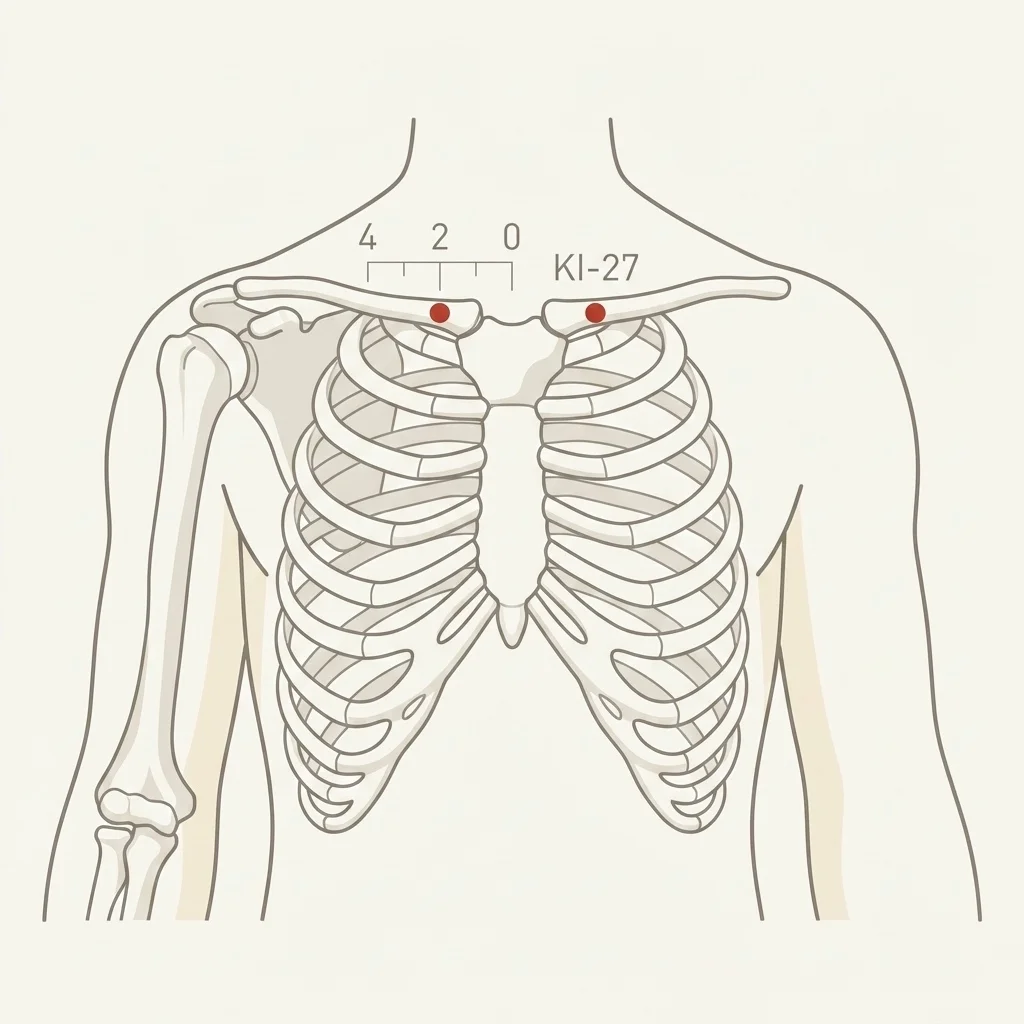
On the chest, in the depression immediately below the inferior border of the clavicle, 2 cun lateral to the anterior midline.
How to find it (practical)
Seated or in dorsal decubitus, locate the point in the depression below the medial end of the clavicle, at the midpoint between the sternal and midclavicular lines, 2 cun lateral to the anterior midline.
Anatomy
Pectoralis major muscle, subclavius muscle. Supraclavicular nerves.
Needling
Transverse-oblique insertion, 0.5–0.8 cun.
Etymology
Shu (俞), point; Fu (府), meeting of Qi and Shen. The Qi of the Shen (Kidney) flows to the Fu organs from this point.
CLASSICAL SOURCEJia Yi Jing

Clinical Relations

Adjacent Points on the Meridian

KI 27 in research

How many Library studies cite this point, since when, and with which designs and verdicts.

Studies
1Library study cites KI 27
By year
2002
Verdict
  • Strong1
Study designs
  • RCT1
Classical source
Jia Yi Jing
Depth
0.5–0.8 cunTransverse

Each study counts once, under the most specific design it states. The verdict is the Library’s word for the strength of each study’s evidence.

See the numbers: KI 27 in research
YearStudies
20021

Often appears with

Points the Library studies cite together with KI 27. It shows research practice, not a prescription.

  1. LU 71 study in common
  2. LI 41 study in common
  3. SI 31 study in common
  4. BL 601 study in common
  5. GV 201 study in common
  6. CV 211 study in common

Each filled mark stands for 5 studies; an open mark, for 1 to 4.

Related Articles

6

Translation and clinical dataProf. Dr. Hong Jin Pai — Meridians: Theory and Clinical Practice, 4th edition. CEIMEC · São Paulo.

CodingWHO Standard Acupuncture Point Locations (2008) for classical and extra points.