Skip to content
KI-6 Zhaohai (照海) — Shining Sea
KI-6
Zhaohai
照海
Shining Sea
★ MajorPonto Confluente do Yin Qiao MaiSafeMembro Inferior
Depth
00.5–1 cun3.0
Perpendicular insertion
Precautions
No special precautions.
Location (classical)
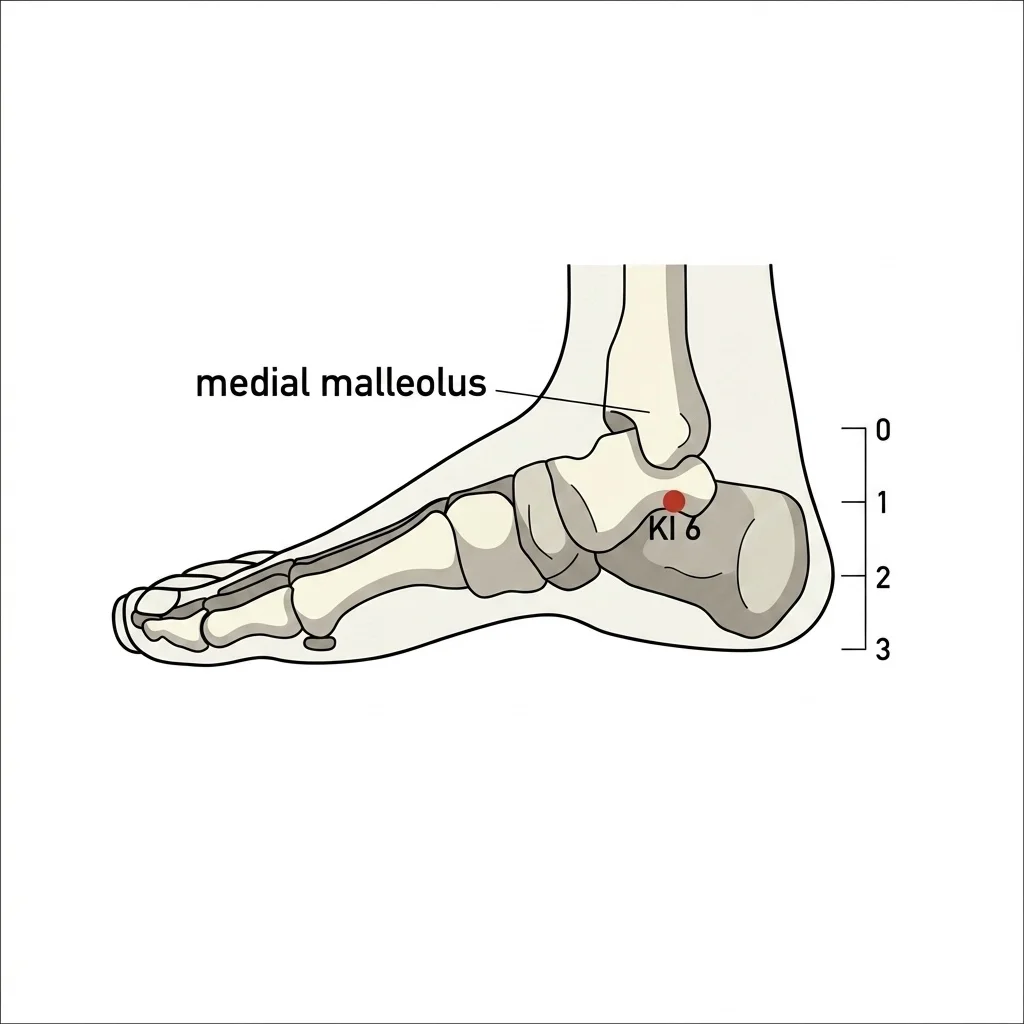
On the medial side of the ankle, in the depression 1 cun directly inferior to the prominence of the medial malleolus.
How to find it (practical)
Identify the prominence of the medial malleolus and the depression below its border, at a distance of 1 B-cun below the prominence.
Anatomy
Tibialis posterior tendon, flexor digitorum longus muscle. Innervated by the saphenous nerve.
Needling
Perpendicular insertion, 0.5–1.0 cun.
Etymology
Zhao (照), to shine; Hai (海), sea. Indicated for the treatment of eye disorders.
CLASSICAL SOURCEJia Yi Jing
Clinical Relations
Classical Combinations
LU-7 LiequeConfluent pair (Ren Mai)
Throat disorders, chest tightness, respiratory and urogenital conditions
Adjacent Points on the Meridian
KI 6 in research
How many Library studies cite this point, since when, and with which designs and verdicts.
- Studies
- 5Library studies cite KI 6
- By year
- 20102026
- Verdict
- Strong2
- Moderate3
- Study designs
- RCT4
- Narrative Review1
- Classical source
- Jia Yi Jing
- Depth
- 0.5–1 cunPerpendicular
Each study counts once, under the most specific design it states. The verdict is the Library’s word for the strength of each study’s evidence.
See the numbers: KI 6 in research
| Year | Studies |
|---|---|
| 2010 | 1 |
| 2022 | 1 |
| 2023 | 1 |
| 2024 | 1 |
| 2026 | 1 |
Often appears with
Points the Library studies cite together with KI 6. It shows research practice, not a prescription.
- SP 64 studies in common
- ST 61 study in common
- ST 301 study in common
- ST 361 study in common
- SP 91 study in common
- HT 71 study in common
- BL 21 study in common
- BL 621 study in common
Each filled mark stands for 5 studies; an open mark, for 1 to 4.