Skip to content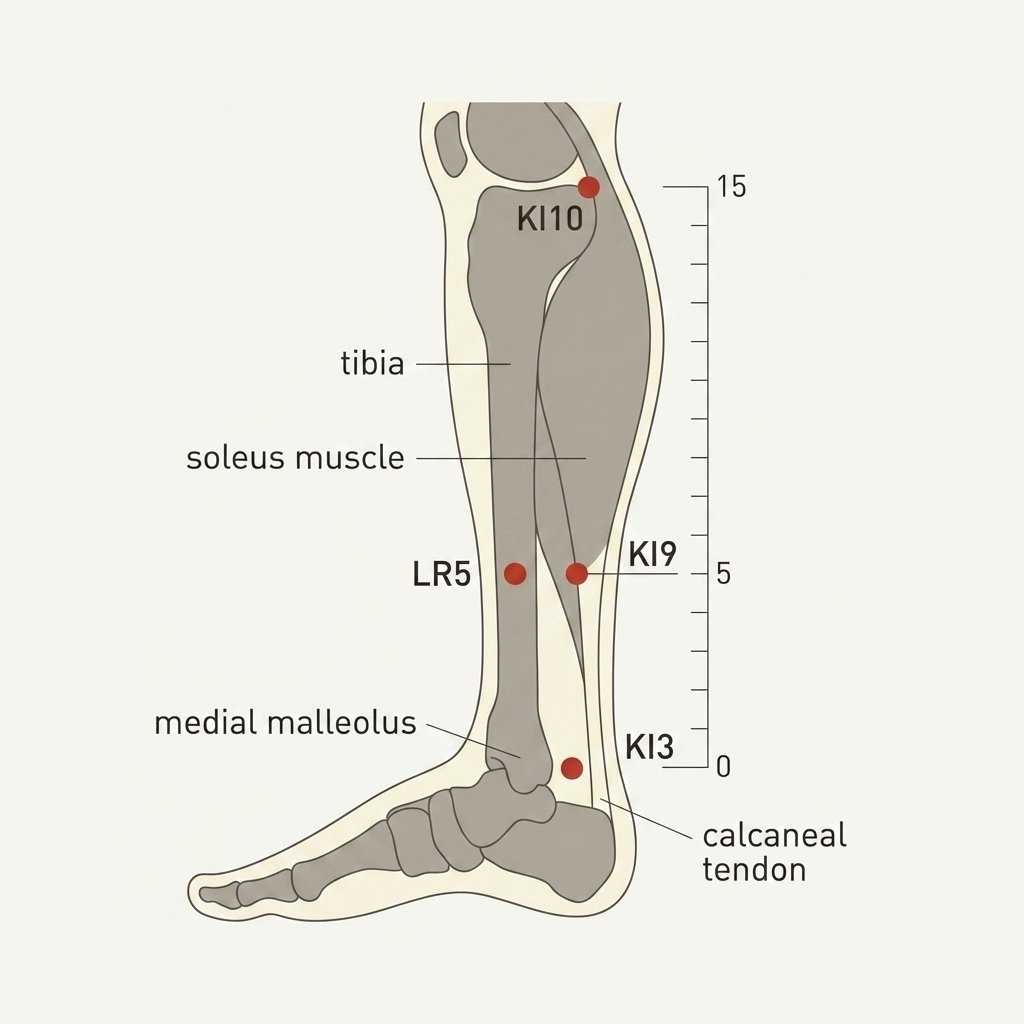
KI-9 Zhubin (築賓) — Guest House
KI-9
Zhubin
築賓
Guest House

Ponto Xi-Fenda do Yin Wei MaiSafeMembro Inferior
Depth
01–1.5 cun3.0
Perpendicular insertion
Precautions
No special precautions.
Location (classical)
On the posteromedial aspect of the leg, between the soleus and the calcaneal tendon, 5 B-cun above the prominence of the medial malleolus.
How to find it (practical)
Measure 5 B-cun above the prominence of the medial malleolus. At this level, identify the interval between the soleus and the calcaneal tendon.
Anatomy
Soleus and gastrocnemius muscles. Innervated by the medial sural cutaneous nerve and the tibial nerve.
Needling
Perpendicular insertion, 1.0–1.5 cun.
Etymology
Zhu (筑), strong; Bin (宾), knee and leg. The point lies on the medial side of the leg. It has the function of strengthening the knee and leg.
CLASSICAL SOURCEJia Yi Jing
Clinical Relations
Adjacent Points on the Meridian
KI 9 in research
How many Library studies cite this point, since when, and with which designs and verdicts.
- Studies
- 1Library study cites KI 9
- By year
- 2018
- Verdict
- Moderate1
- Study designs
- Narrative Review1
- Classical source
- Jia Yi Jing
- Depth
- 1–1.5 cunPerpendicular
Each study counts once, under the most specific design it states. The verdict is the Library’s word for the strength of each study’s evidence.
See the numbers: KI 9 in research
| Year | Studies |
|---|---|
| 2018 | 1 |
Often appears with
Points the Library studies cite together with KI 9. It shows research practice, not a prescription.
Each filled mark stands for 5 studies; an open mark, for 1 to 4.