Skip to content
Skip to content

KI-17 Shangqu (商曲) — Shang Bend

KI-17
Shangqu
商曲
Shang Bend
KI-17 Shangqu — Shang Bend
Encontro com Chong MaiSafeAbdômen
Depth
01–1.5 cun3.0
Perpendicular insertion
Precautions
Deep insertion may reach the peritoneal cavity.
Location (classical)
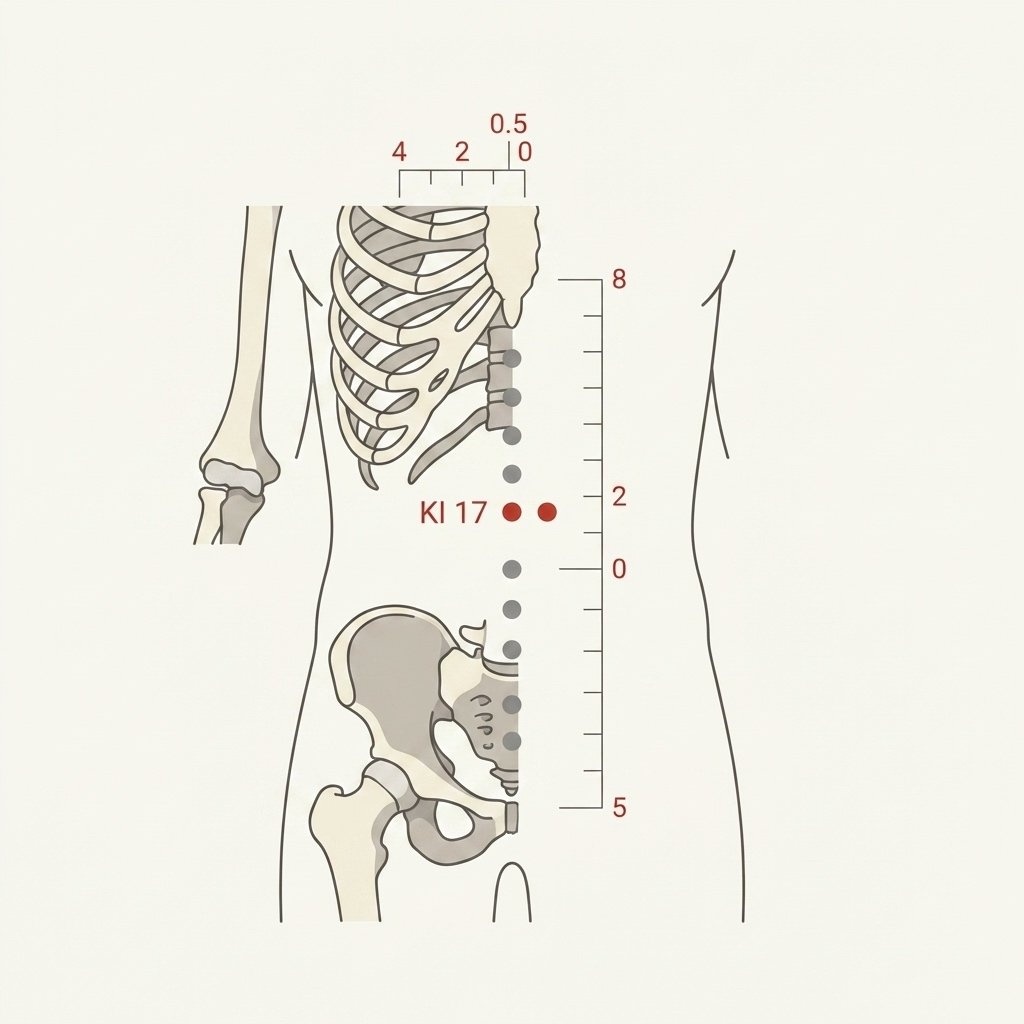
On the upper abdomen, 2 cun above the umbilicus, 0.5 cun lateral to the anterior midline (at the level of CV-10).
How to find it (practical)
In dorsal decubitus, locate the point 2 cun above the umbilicus, 0.5 cun lateral to the anterior midline, at the level of Xia Wan (CV-10).
Anatomy
Rectus abdominis muscle. 9th intercostal nerve.
Needling
Perpendicular insertion, 1.0–1.5 cun.
Etymology
Shang (商), one of the five notes of the ancient five-tone musical scale; Qu (曲), bend. Shang is a musical note belonging to Metal, as is the Da Chang (Large Intestine). This point lies near the bends of the Chang (intestines).
CLASSICAL SOURCEJia Yi Jing

Clinical Relations

Adjacent Points on the Meridian

KI 17 in research

How many Library studies cite this point, since when, and with which designs and verdicts.

Studies
1Library study cites KI 17
By year
2017
Verdict
  • Strong1
Study designs
  • RCT1
Classical source
Jia Yi Jing
Depth
1–1.5 cunPerpendicular

Each study counts once, under the most specific design it states. The verdict is the Library’s word for the strength of each study’s evidence.

See the numbers: KI 17 in research
YearStudies
20171

Often appears with

Points the Library studies cite together with KI 17. It shows research practice, not a prescription.

  1. ST 241 study in common
  2. CV 41 study in common
  3. CV 121 study in common

Each filled mark stands for 5 studies; an open mark, for 1 to 4.

Related Articles

4

Translation and clinical dataProf. Dr. Hong Jin Pai — Meridians: Theory and Clinical Practice, 4th edition. CEIMEC · São Paulo.

CodingWHO Standard Acupuncture Point Locations (2008) for classical and extra points.