Skip to content
Skip to content

CV-24 Chengjiang (承漿) — Sauce Receptacle

CV-24
Chengjiang
承漿
Sauce Receptacle · Container of Fluids
CV-24 Chengjiang — Sauce Receptacle
Encontro Ren Mai-Du MaiIntestino Grossoe canal do EstômagoSafeCabeça
Depth
00.3–0.5 cun3.0
Oblique insertion
Precautions
No standard precautions.
Location (classical)
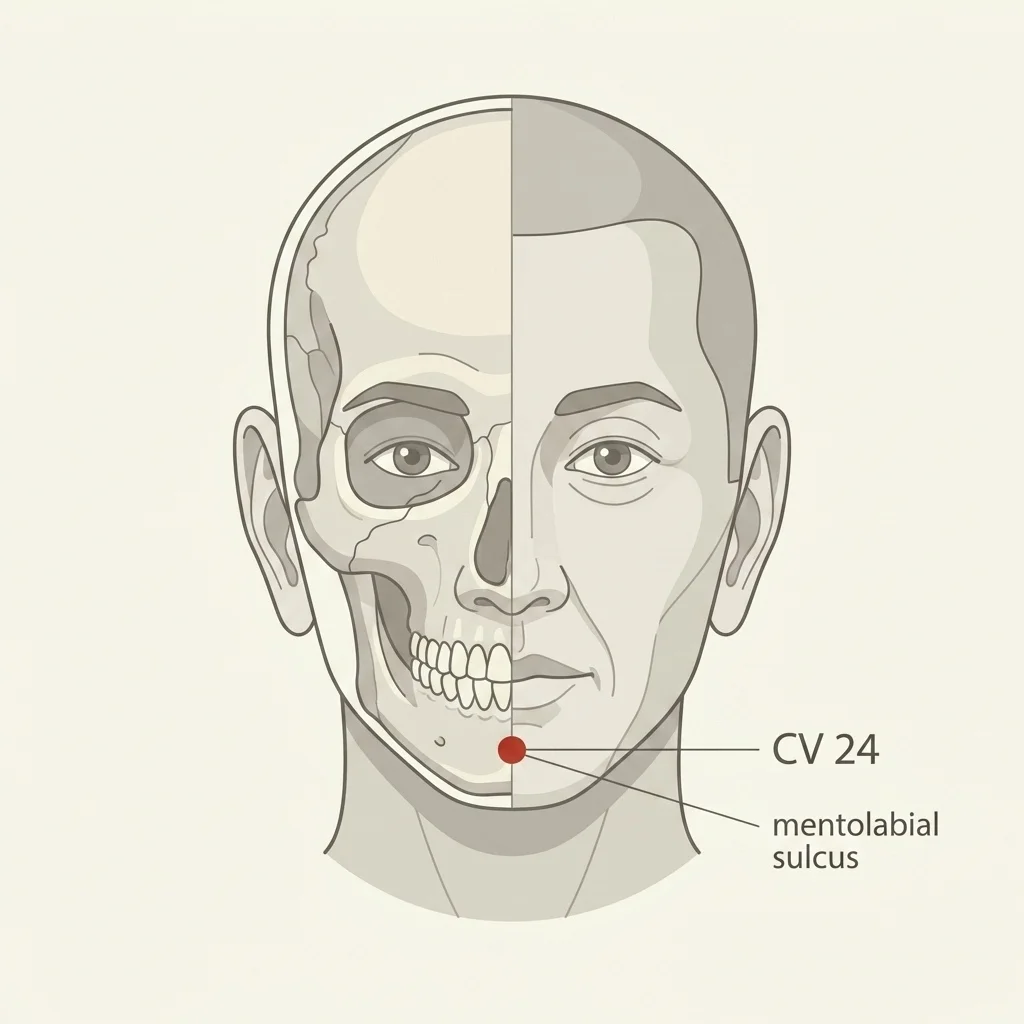
On the face, in the depression in the center of the mentolabial sulcus (directly below the lower lip).
How to find it (practical)
Seated with the neck in extension, locate the point in the depression in the center of the mentolabial sulcus. Figure 7.12 — Point of the Ren Mai (neck and face). Figure 7.13 — Insertion of the needle at the point Lian Quan.
Anatomy
Orbicularis oris muscle. Innervated by the mental nerve (branch of the trigeminal nerve) and by the facial nerve.
Needling
Oblique insertion directed superiorly, 0.3–0.5 cun.
Etymology
Cheng (承), receiving; Jiang (漿), fluid. Saliva accumulates in this place.
CLASSICAL SOURCEZhen Jin Zi Sheng Jing

Clinical Relations

Adjacent Points on the Meridian

CV 24 in research

How many Library studies cite this point, since when, and with which designs and verdicts.

Studies
3Library studies cite CV 24
By year
20232024
Verdict
  • Strong1
  • Moderate2
Study designs
  • RCT1
  • Other designs2
Classical source
Zhen Jin Zi Sheng Jing
Depth
0.3–0.5 cunOblique

Each study counts once, under the most specific design it states. The verdict is the Library’s word for the strength of each study’s evidence.

See the numbers: CV 24 in research
YearStudies
20231
20242

Often appears with

Points the Library studies cite together with CV 24. It shows research practice, not a prescription.

  1. LI 42 studies in common
  2. LU 71 study in common
  3. LI 11 study in common
  4. ST 11 study in common
  5. ST 41 study in common
  6. ST 61 study in common
  7. HT 71 study in common
  8. BL 11 study in common

Each filled mark stands for 5 studies; an open mark, for 1 to 4.

Related Articles

3

Translation and clinical dataProf. Dr. Hong Jin Pai — Meridians: Theory and Clinical Practice, 4th edition. CEIMEC · São Paulo.

CodingWHO Standard Acupuncture Point Locations (2008) for classical and extra points.