Encontro da BexigaIntestino DelgadoEstômagoCautionCabeça
Depth
00.3 cun3.0
Perpendicular insertion
Precautions
HIGH RISK. Lifting, thrusting, or rotation are absolutely prohibited. After withdrawal, press firmly with a sterile cotton ball for 1–2 minutes to prevent severe hematoma ("black eye"). Moxibustion is strictly contraindicated. Caution: angular artery and vein, eyeball, periosteum. Should only be needled by experienced practitioners. Press firmly with cotton for approximately one minute on withdrawal to avoid hematoma. No needle stimulation. Moxibustion contraindicated.
Location (classical)
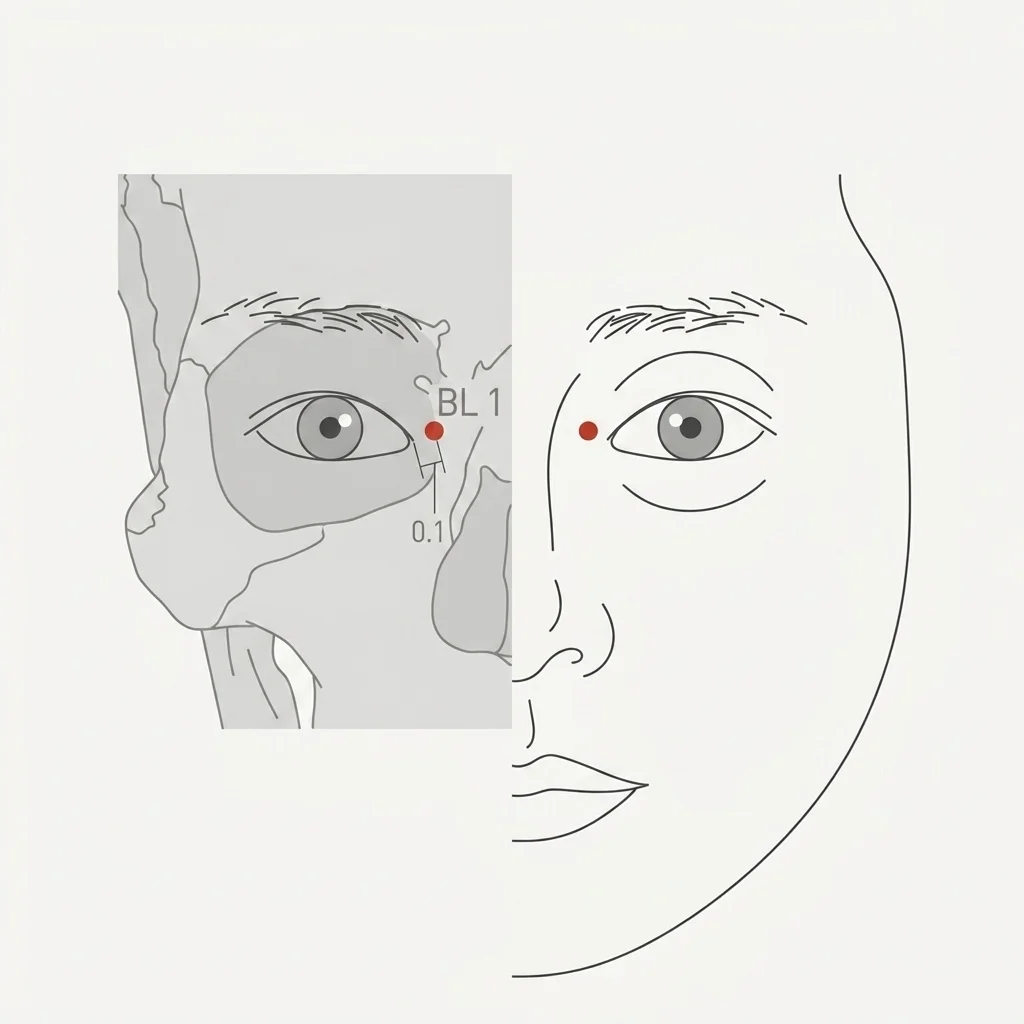
0.1 cun superior and medial to the inner canthus of the eye, in a depression where the temple of a pair of glasses tends to rest.
How to find it (practical)
Seated or in dorsal decubitus, locate the point 0.1 cun medial and 0.1 cun above the medial commissure of the eye, near the medial margin of the orbit.
Anatomy
Skin, subcutaneous tissue, trigeminal nerve (infratrochlear and supratrochlear branches), branches of the facial nerve, supraorbital artery and vein, supratrochlear artery and vein, nasofrontal vein, dorsal nasal artery and vein, and orbicularis oculi muscle.
Needling
Perpendicular insertion, 0.3 cun. Do not lift, thrust or rotate the needle.
Etymology
Jing (腈), eye; Ming (明), brightness. The point lies near the eyes and its function is to treat ocular disorders.