EX-B9 Yao Qi () — Yao Qi — Lumbar Wonder
Sacrococcygeal close-up: on the posterior midline, in the depression between the sacral cornua, 2 cun above the tip of the coccyx
Anatomical illustration acupuntura.com · verified against Focks (2008), WHO/WPRO (2008), and Pontos e Meridianos
Anatomical location
In ventral decubitus, locate the point 2 cun directly above the coccyx.
Practical palpation guide
In ventral decubitus, locate the point 2 cun directly above the coccyx.
Comparison across atlases & standards
Pontos e Meridianos (p. 437) also describes perpendicular insertion of only 0.3 cun as an alternative. The 1 to 1.5 cun range applies to the cranial tangential course, as also described by the Chinese People’s Medical Publishing House. Taiwan’s Yi Bian gives 2 to 2.5 cun for that course. Kyung Hee University describes two successive steps: perpendicular insertion of 0.3 cun followed by a cranial tangential course. This atlas retains the historical location in GB 12346–90, section 4.3.9. Yaoqi was removed from the list of extra points in GB/T 40997–2021.
Needling technique
Tangential needling along the skin in a cranial direction. The course described in the textbook is 1 to 1.5 cun. The textbook also describes perpendicular insertion of 0.3 cun.
Medical application & myofascial correlation
Clinical practice indications
- 01Epilepsy
- 02Headache
- 03Insomnia and constipation
Presenting symptoms & complaints
Classical tradition, channel actions & source
Traditional indications (TCM)
Functional classification
Layered tissue anatomy & needle biomechanics at EX-B9
Cross-sectional technical schematic of perpendicular insertion (90°) (calibrated depth): superficial connective collagen coupling, intramuscular myofascial transduction, and deep neurovascular protection.
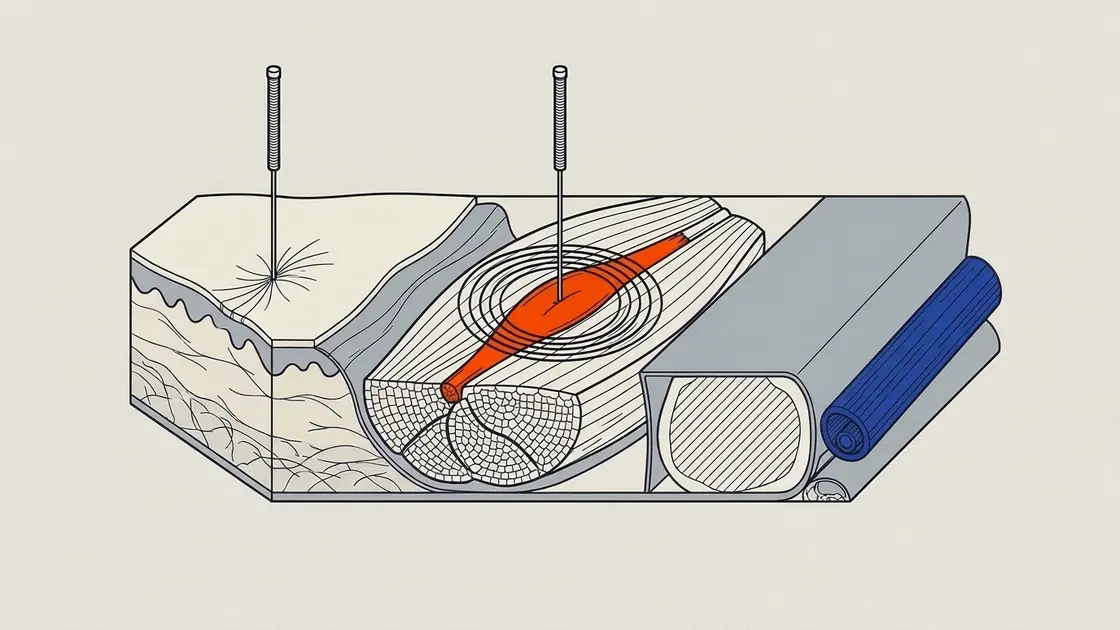
Dermal & fascial collagen coupling
A solid non-cutting filiform needle (0.25 mm rounded tip) enters via perpendicular insertion (90°), gently tenting loose areolar collagen fibers without slicing dermal vessels.
Myofascial spindle & Aδ / C transduction
Within the calibrated depth target window at EX-B9, mechanical coupling recruits intramuscular mechanoreceptors, increasing local micro-perfusion and releasing taut bands.
Deep neurovascular clearance
Calibrated angle and depth keep the needle tip clear of periosteum and deep neurovascular trunks, pairing targeted stimulation with anatomical safety.