EX-UE3 Zhong Quan () — Zhong Quan — Central Spring
Dorsal wrist close-up (Zhongquan): in depression on radial side of extensor digitorum tendon
Anatomical illustration acupuntura.com · verified against Focks (2008), WHO/WPRO (2008), and Pontos e Meridianos
Anatomical location
On the dorsum of the hand, at the wrist crease, in the depression on the radial side of the tendon of the extensor digitorum communis muscle. (Fig. 12.15)
Practical palpation guide
With the elbow flexed and the palm facing downward, locate the point at the midpoint of the line connecting Yang Chi (TE-4) and Yang Xi (LI-5).
Needling technique
0.3 to 0.5 cun · perpendicular
Medical application & myofascial correlation
Clinical practice indications
- 01Cataract
- 02Sensation of fullness in the chest
- 03Difficulty supinating the forearm
- 04Nausea and vomiting
- 05Hemoptysis
- 06Pain in the chest and abdomen
- 07Sensation of heat in the palms
- 08Distending pain in the lung
- 09Low back pain
Presenting symptoms & complaints
Classical tradition, channel actions & source
Traditional indications (TCM)
Functional classification
Layered tissue anatomy & needle biomechanics at EX-UE3
Cross-sectional technical schematic of perpendicular insertion (90°) (0.3–0.5 cun): superficial connective collagen coupling, intramuscular myofascial transduction, and deep neurovascular protection.
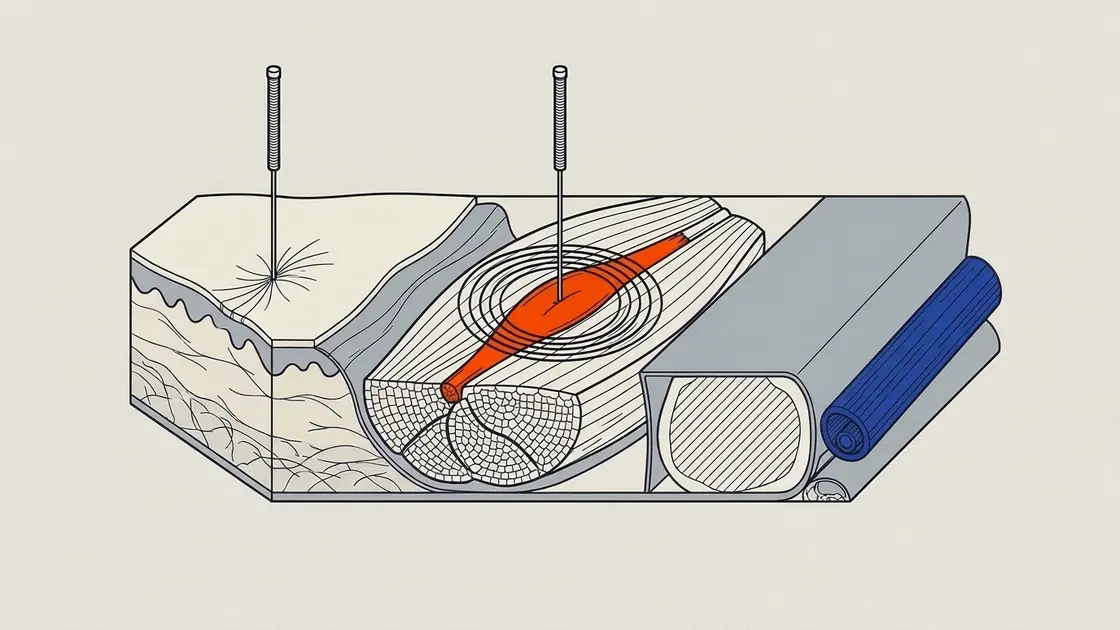
Dermal & fascial collagen coupling
A solid non-cutting filiform needle (0.25 mm rounded tip) enters via perpendicular insertion (90°), gently tenting loose areolar collagen fibers without slicing dermal vessels.
Myofascial spindle & Aδ / C transduction
Within the 0.3–0.5 cun target window at EX-UE3, mechanical coupling recruits intramuscular mechanoreceptors, increasing local micro-perfusion and releasing taut bands.
Deep neurovascular clearance
Calibrated angle and depth keep the needle tip clear of periosteum and deep neurovascular trunks, pairing targeted stimulation with anatomical safety.