EX-LE6 Dan Nang () — Dan Nang — Gallbladder Point
Fibular close-up: 2 B-cun directly below the head of the fibula (GB/T 40997–2021; 2 cun below GB 34 in Pontos e Meridianos)
Anatomical illustration acupuntura.com · verified against Focks (2008), WHO/WPRO (2008), and Pontos e Meridianos
Anatomical location
On the lateral aspect of the leg, 2 cun directly below the head of the fibula, according to the standard GB/T 40997–2021. (Fig. 12.21)
Practical palpation guide
Identify the head of the fibula as the origin of the 2 cun measurement.
Needling technique
1 to 1.5 cun · perpendicular
Medical application & myofascial correlation
Clinical practice indications
- 01Biliary diseases
- 02Jaundice
- 03Biliary colic
- 04Cholecystitis
- 05Facial paralysis
- 06Paralysis of the lower limb and pain in the hypochondrium
Presenting symptoms & complaints
Classical tradition, channel actions & source
Traditional indications (TCM)
Functional classification
Layered tissue anatomy & needle biomechanics at EX-LE6
Cross-sectional technical schematic of perpendicular insertion (90°) (calibrated depth): superficial connective collagen coupling, intramuscular myofascial transduction, and deep neurovascular protection.
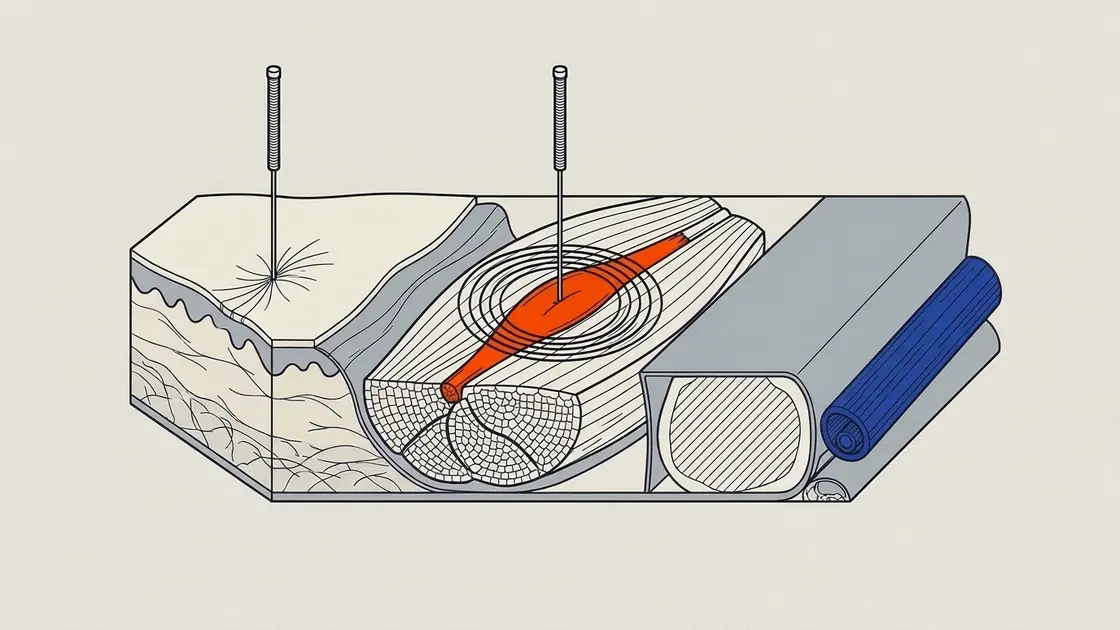
Dermal & fascial collagen coupling
A solid non-cutting filiform needle (0.25 mm rounded tip) enters via perpendicular insertion (90°), gently tenting loose areolar collagen fibers without slicing dermal vessels.
Myofascial spindle & Aδ / C transduction
Within the calibrated depth target window at EX-LE6, mechanical coupling recruits intramuscular mechanoreceptors, increasing local micro-perfusion and releasing taut bands.
Deep neurovascular clearance
Calibrated angle and depth keep the needle tip clear of periosteum and deep neurovascular trunks, pairing targeted stimulation with anatomical safety.