EX-LE4 Nei Xi Yan () — Nei Xi Yan — Inner Knee Eye
Knee joint close-up: MEDIAL infrapatellar depression beside the patellar ligament
Anatomical illustration acupuntura.com · verified against Focks (2008), WHO/WPRO (2008), and Pontos e Meridianos
Anatomical location
In the medial depression of the patellar ligament. (Fig. 12.19)
Practical palpation guide
Seated, with the knee flexed, locate the point in the medial depression, just below the patella.
Comparison across atlases & standards
PMPH describes an oblique anteromedial-to-posterolateral course. Yi Bian describes perpendicular needling over the same range. The team’s textbook also mentions a deep variant without a specified measurement.
Needling technique
At the depression medial to the patellar ligament, the textbook describes oblique needling toward the center of the knee, 0.5 to 1 cun. It also permits moxibustion.
Medical application & myofascial correlation
Clinical practice indications
- 01Painful sensation
- 02Edema and pain of the knee joint
- 03Arthritis of the knee
- 04Combine with Kuan Gu (EX-LE1) for leg pain
Presenting symptoms & complaints
Classical tradition, channel actions & source
Traditional indications (TCM)
Functional classification
Layered tissue anatomy & needle biomechanics at EX-LE4
Cross-sectional technical schematic of perpendicular insertion (90°) (calibrated depth): superficial connective collagen coupling, intramuscular myofascial transduction, and deep neurovascular protection.
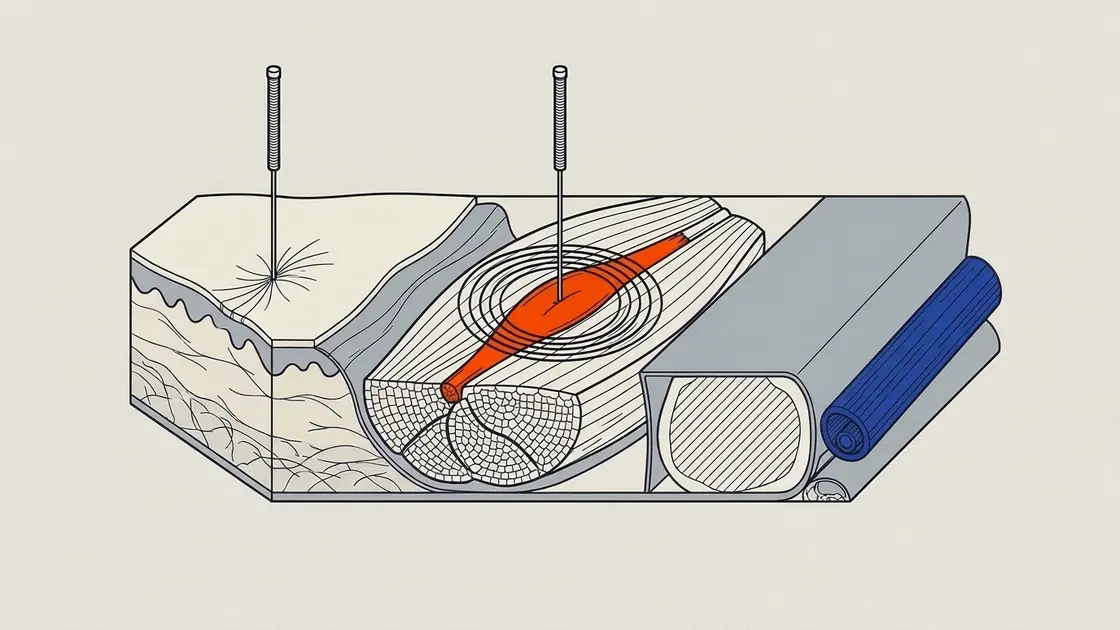
Dermal & fascial collagen coupling
A solid non-cutting filiform needle (0.25 mm rounded tip) enters via perpendicular insertion (90°), gently tenting loose areolar collagen fibers without slicing dermal vessels.
Myofascial spindle & Aδ / C transduction
Within the calibrated depth target window at EX-LE4, mechanical coupling recruits intramuscular mechanoreceptors, increasing local micro-perfusion and releasing taut bands.
Strict anatomical safety floor
The deep fascial septum, bone cortex, and underlying neurovascular bundle or cavity define the strict anatomical boundary observed during physician needling at EX-LE4.
Clinical trial protocols using this point
- studies cite this point
- 12 studies cite this point
- RCTs
- 5 RCTs
- sham-controlled
- 9 sham-controlled
Top clinical conditions tested
Most frequent synergistic partner points
Clinical Protocols & Trials Using This Point
Clinical conditions in our trial library where EX-LE4 ranks among the core protocol points (2 mapped protocols).
EX-LE4 in research
How many Library studies cite this point, since when, and with which designs and verdicts.
- Studies
- 8Library studies cite EX-LE4
- By year
- 20162025
- Verdict
- Strong4
- Moderate3
- Limited1
- Study designs
- Meta-analysis2
- RCT3
- Clinical Guideline1
- Narrative Review1
- Other designs1
- Classical source
- Bei Ji Qian Jin Yao Fang
Each study counts once, under the most specific design it states. The verdict is the Library’s word for the strength of each study’s evidence.
See the numbers: EX-LE4 in research
| Year | Studies |
|---|---|
| 2016 | 1 |
| 2020 | 1 |
| 2021 | 1 |
| 2023 | 2 |
| 2024 | 1 |
| 2025 | 2 |
Often appears with
Points the Library studies cite together with EX-LE4. It shows research practice, not a prescription.
- ST 356 studies in common
- GB 346 studies in common
- SP 95 studies in common
- ST 344 studies in common
- SP 104 studies in common
- ST 362 studies in common
- SP 62 studies in common
- EX-LE52 studies in common
Each filled mark stands for 5 studies; an open mark, for 1 to 4.