EX-UE2 Er Bai () — Er Bai — Two Whites
Two points on anterior forearm, 4 B-cun proximal to palmar wrist crease, radial and ulnar to FCR tendon
Anatomical illustration acupuntura.com · verified against Focks (2008), WHO/WPRO (2008), and Pontos e Meridianos
Anatomical location
On the anterior forearm, 4 cun proximal to the wrist crease, one point on either side of the flexor carpi radialis tendon.
Practical palpation guide
Measure 4 cun toward the elbow from the distal palmar wrist crease. There are two points on each forearm at this level, one on each side of the flexor carpi radialis tendon.
Comparison across atlases & standards
Yi Bian gives the same perpendicular approach and range as the textbook. PMPH also describes a perpendicular approach but gives 0.3 to 0.5 cun.
Needling technique
The team’s textbook describes perpendicular needling at 0.5 to 0.8 cun and permits moxibustion. On each forearm, one point lies on either side of the flexor carpi radialis tendon.
Medical application & myofascial correlation
Clinical practice indications
- 01Hemorrhoids with bleeding, pain and pruritus
- 02"rectal prolapse"
- 03Pain in the forearm
- 04In the chest and hypochondrium
Presenting symptoms & complaints
Classical tradition, channel actions & source
Traditional indications (TCM)
Functional classification
Layered tissue anatomy & needle biomechanics at EX-UE2
Cross-sectional technical schematic of perpendicular insertion (90°) (calibrated depth): superficial connective collagen coupling, intramuscular myofascial transduction, and deep neurovascular protection.
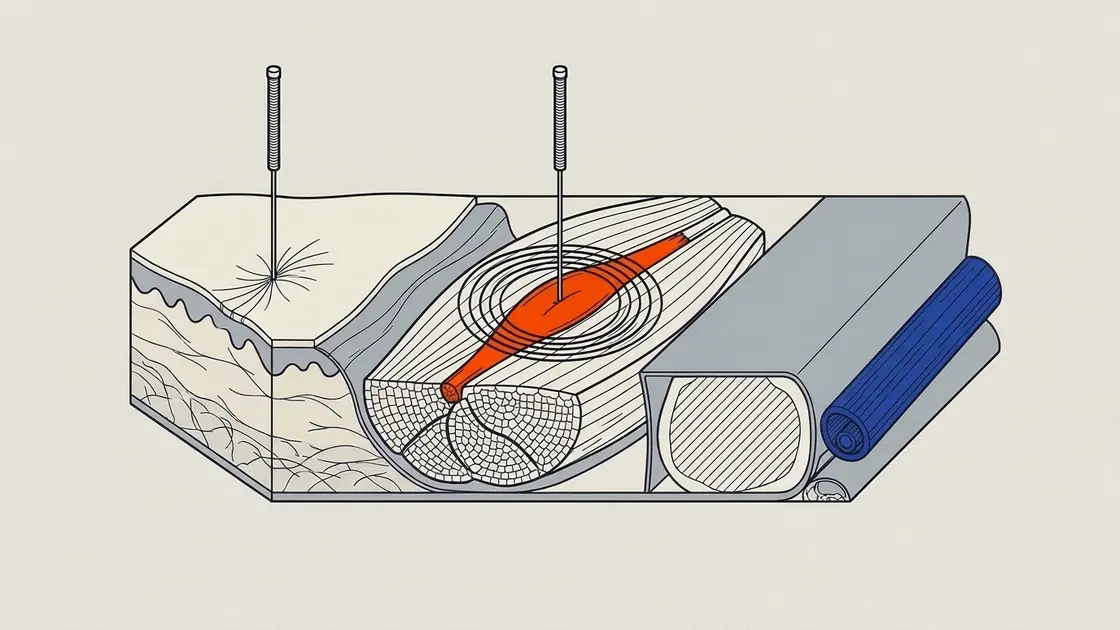
Dermal & fascial collagen coupling
A solid non-cutting filiform needle (0.25 mm rounded tip) enters via perpendicular insertion (90°), gently tenting loose areolar collagen fibers without slicing dermal vessels.
Myofascial spindle & Aδ / C transduction
Within the calibrated depth target window at EX-UE2, mechanical coupling recruits intramuscular mechanoreceptors, increasing local micro-perfusion and releasing taut bands.
Deep neurovascular clearance
Calibrated angle and depth keep the needle tip clear of periosteum and deep neurovascular trunks, pairing targeted stimulation with anatomical safety.