EX-B1 Ding Chuan () — Ding Chuan — Calm Asthma
Level with the lower border of the C7 spinous process, 0.5 B-cun lateral to the posterior midline
Anatomical illustration acupuntura.com · verified against Focks (2008), WHO/WPRO (2008), and Pontos e Meridianos
Anatomical location
At the level of the inferior border of the C7 spinous process, 0.5 cun on either side of the posterior midline.
Practical palpation guide
Identify the C7 spinous process on the midline. At the level immediately below it, measure 0.5 cun to either side.
Comparison across atlases & standards
A Chinese multicenter protocol describes both approaches. The Chinese textbook Zhenjiuxue gives only the perpendicular approach, at 0.5 to 0.8 cun. The posterior landmark is the C7 spinous process. The printed reference to the uncinate process does not identify this posterior landmark.
Needling technique
Pontos e Meridianos describes two options near C7, both 0.5 to 1 cun. The approach may be perpendicular or oblique toward the spine. The textbook also permits moxibustion.
Medical application & myofascial correlation
Clinical practice indications
- 01Asthma
- 02Cough
- 03Urticaria
- 04Stiffness of the neck and shoulder
- 05Pain in the back and upper limbs
Presenting symptoms & complaints
Classical tradition, channel actions & source
Traditional indications (TCM)
Functional classification
Layered tissue anatomy & needle biomechanics at EX-B1
Cross-sectional technical schematic of perpendicular insertion (90°) (calibrated depth): superficial connective collagen coupling, intramuscular myofascial transduction, and deep neurovascular protection.
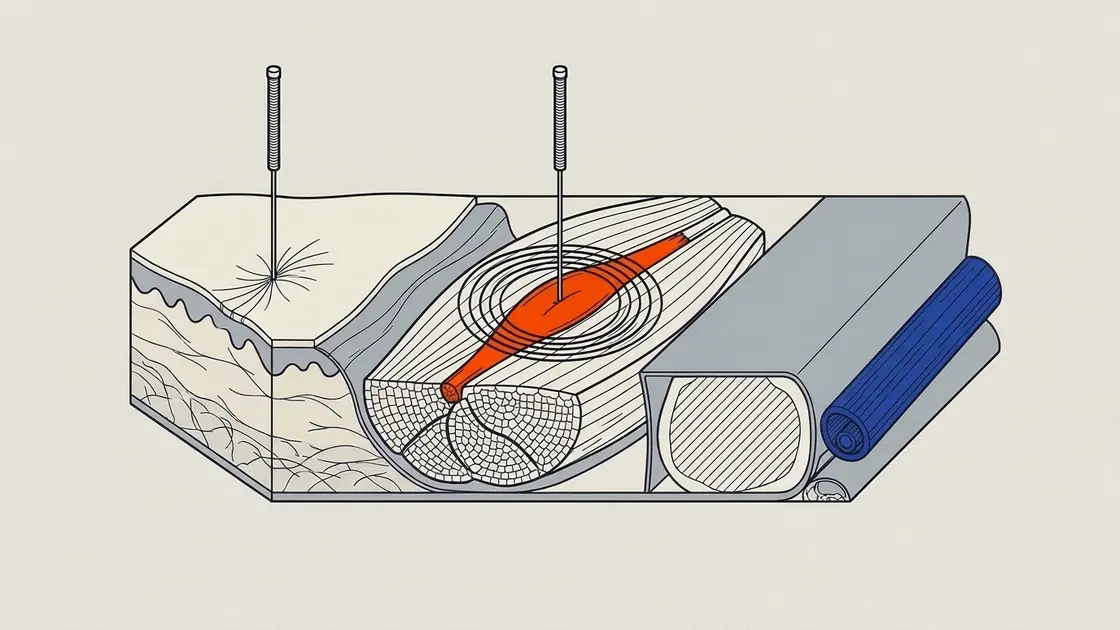
Dermal & fascial collagen coupling
A solid non-cutting filiform needle (0.25 mm rounded tip) enters via perpendicular insertion (90°), gently tenting loose areolar collagen fibers without slicing dermal vessels.
Myofascial spindle & Aδ / C transduction
Within the calibrated depth target window at EX-B1, mechanical coupling recruits intramuscular mechanoreceptors, increasing local micro-perfusion and releasing taut bands.
Strict anatomical safety floor
The deep fascial septum, bone cortex, and underlying neurovascular bundle or cavity define the strict anatomical boundary observed during physician needling at EX-B1.
EX-B1 in research
How many Library studies cite this point, since when, and with which designs and verdicts.
- Studies
- 2Library studies cite EX-B1
- By year
- 20242025
- Verdict
- Strong1
- Moderate1
- Study designs
- Systematic Review1
- Narrative Review1
- Classical source
- Zhong Guo Zhen Jiu Xue
Each study counts once, under the most specific design it states. The verdict is the Library’s word for the strength of each study’s evidence.
See the numbers: EX-B1 in research
| Year | Studies |
|---|---|
| 2024 | 1 |
| 2025 | 1 |
Often appears with
Points the Library studies cite together with EX-B1. It shows research practice, not a prescription.
Each filled mark stands for 5 studies; an open mark, for 1 to 4.