EX-HN4 Yu Yao () — Yu Yao — Fish Waist
Orbital close-up: midpoint of the eyebrow, directly on the vertical straight-ahead pupil axis
Anatomical illustration acupuntura.com · verified against Focks (2008), WHO/WPRO (2008), and Pontos e Meridianos
Anatomical location
On the forehead, directly above the pupil, in the middle of the eyebrow. (Fig. 12.2)
Practical palpation guide
With the patient looking forward, locate the point in the middle of the eyebrow, directly above the pupil.
Comparison across atlases & standards
Pontos e Meridianos (p. 430) gives a transverse course of 0.5 cun. China’s People’s Medical Publishing House describes a tangential course of 0.3 to 0.5 cun and also a short perpendicular variant. Taiwan’s Yi Bian describes a transverse course of 0.5 to 1 cun and contraindicates moxibustion.
Needling technique
The team’s textbook describes transverse needling in the subcutaneous tissue of the eyebrow, with a course of 0.5 cun. It contraindicates moxibustion.
Medical application & myofascial correlation
Clinical practice indications
- 01Edema
- 02Eye pain and hyperemia
- 03Blurred vision
- 04Eyelid tic
- 05Palpebral ptosis
- 06Facial paralysis
- 07Supraorbital neuralgia
- 08Acute conjunctivitis
- 09For keratitis
- 10Combine with Guang Ming (GB-37)
- 11Facial nerve palsy
- 12Ocular paralysis
Presenting symptoms & complaints
Classical tradition, channel actions & source
Traditional indications (TCM)
Functional classification
Layered tissue anatomy & needle biomechanics at EX-HN4
Cross-sectional technical schematic of perpendicular insertion (90°) (calibrated depth): superficial connective collagen coupling, intramuscular myofascial transduction, and deep neurovascular protection.
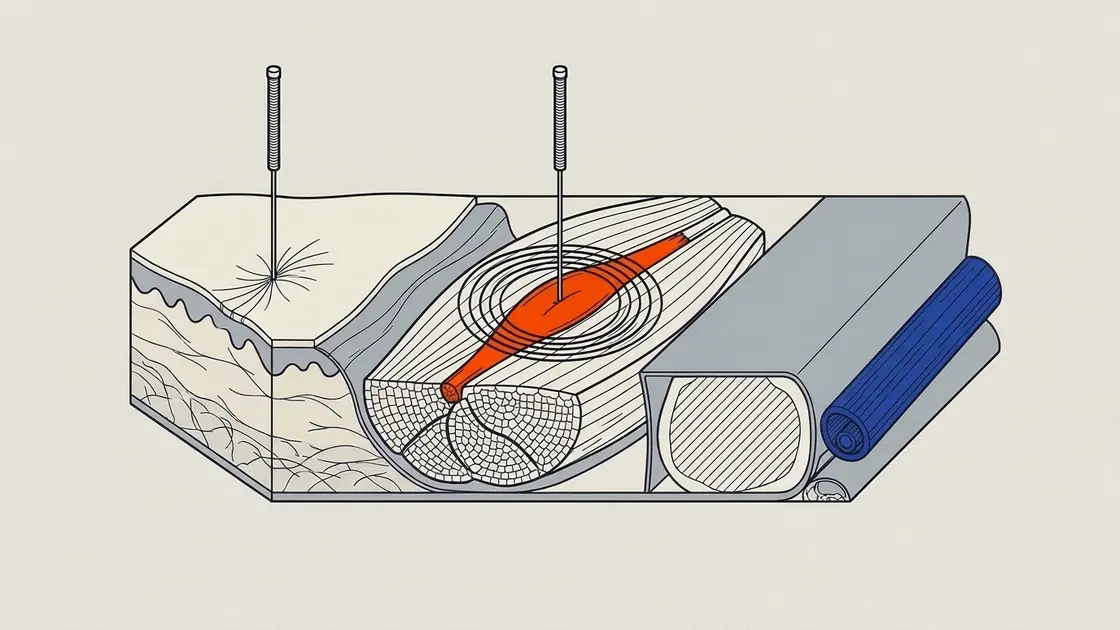
Dermal & fascial collagen coupling
A solid non-cutting filiform needle (0.25 mm rounded tip) enters via perpendicular insertion (90°), gently tenting loose areolar collagen fibers without slicing dermal vessels.
Myofascial spindle & Aδ / C transduction
Within the calibrated depth target window at EX-HN4, mechanical coupling recruits intramuscular mechanoreceptors, increasing local micro-perfusion and releasing taut bands.
Deep neurovascular clearance
Calibrated angle and depth keep the needle tip clear of periosteum and deep neurovascular trunks, pairing targeted stimulation with anatomical safety.
EX-HN4 in research
How many Library studies cite this point, since when, and with which designs and verdicts.
- Studies
- 2Library studies cite EX-HN4
- By year
- 20152025
- Verdict
- Moderate2
- Study designs
- RCT1
- Other designs1
- Classical source
- Zhen Jiu Da Cheng
Each study counts once, under the most specific design it states. The verdict is the Library’s word for the strength of each study’s evidence.
See the numbers: EX-HN4 in research
| Year | Studies |
|---|---|
| 2015 | 1 |
| 2025 | 1 |
Often appears with
Points the Library studies cite together with EX-HN4. It shows research practice, not a prescription.
- LI 42 studies in common
- ST 42 studies in common
- ST 62 studies in common
- LI 101 study in common
- LI 201 study in common
- ST 11 study in common
- ST 21 study in common
- ST 81 study in common
Each filled mark stands for 5 studies; an open mark, for 1 to 4.