EX-B2 Jia Ji () — Hua Tuo Jia Ji — Hua Tuo's Paraspinal Points
Thoracic Huatuo Jiaji (T1–T12, 12 pairs): 0.5 B-cun lateral to the lower border of each spinous process (17 pairs T1–L5 = 34 points)
Anatomical illustration acupuntura.com · verified against Focks (2008), WHO/WPRO (2008), and Pontos e Meridianos
Anatomical location
From T1 to L5, one pair per level at the inferior border of each spinous process, 0.5 cun on either side of the posterior midline. There are 17 pairs, or 34 points.
Practical palpation guide
Identify the spinous processes from T1 to L5. At each level, measure 0.5 cun laterally from the midline.
Anatomical plane & innervation
In the paraspinal musculature, the relationship to the posterior rami of the spinal nerves and accompanying vessels varies by vertebral level.
Comparison across atlases & standards
The standardized series has 17 thoracic and lumbar pairs. Some schools describe cervical extensions separately. Zhenjiuxue gives the same range as the team’s textbook. Focks distinguishes thoracic and lumbar approaches and describes a medially oblique variant. An anatomical study of the lumbar region does not establish a single 45-degree angle for every level.
Needling technique
For the 17 pairs of Jiaji points from T1 to L5, the textbook describes perpendicular needling at 0.3 to 0.5 cun. It also describes bloodletting by tapping with a plum-blossom needle as an alternative and permits moxibustion.
Medical application & myofascial correlation
Clinical practice indications
- 01Herpes zoster (in the corresponding dermatome)
- 02Tuberculosis
- 03Pulmonary emphysema
- 04Chronic bronchitis
- 05Chronic anemia
Presenting symptoms & complaints
Classical tradition, channel actions & source
Classical therapeutic actions
- Stimulates and regulates the Zang-Fu organs according to the segmental spinal level
- Activates the channels and collateral vessels (luo)
- Relieves pain
Traditional indications (TCM)
Segmental level correspondence
| Segment | Organs / Region |
|---|---|
| C1–C7 | Distúrbios locais da região cervical |
| T1–T4 | Pulmão e membros superiores |
| T4–T7 | Coração |
| T7–T10 | Fígado e Vesícula Biliar |
| T10–T12 | Baço e Estômago |
| L1–L2 | Rins |
| L3–L5 | Bexiga, intestinos delgado e grosso, útero e membros inferiores |
Functional classification
Layered tissue anatomy & needle biomechanics at EX-B2
Cross-sectional technical schematic of perpendicular insertion (90°) (calibrated depth): superficial connective collagen coupling, intramuscular myofascial transduction, and deep neurovascular protection.
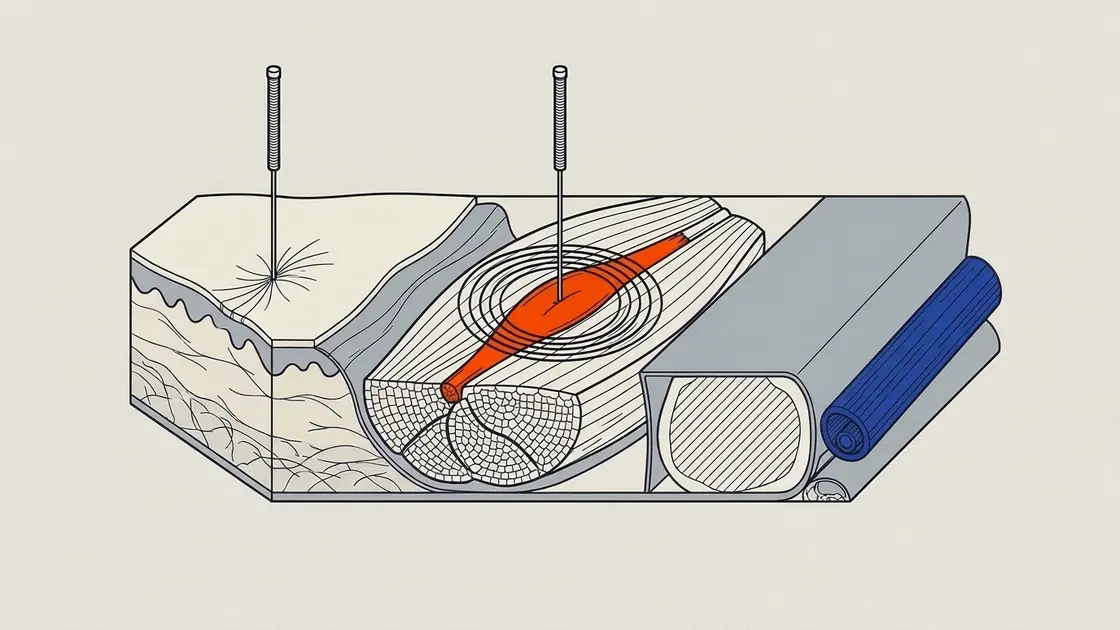
Dermal & fascial collagen coupling
A solid non-cutting filiform needle (0.25 mm rounded tip) enters via perpendicular insertion (90°), gently tenting loose areolar collagen fibers without slicing dermal vessels.
Myofascial spindle & Aδ / C transduction
Within the calibrated depth target window at EX-B2, mechanical coupling recruits intramuscular mechanoreceptors, increasing local micro-perfusion and releasing taut bands.
Strict anatomical safety floor
The deep fascial septum, bone cortex, and underlying neurovascular bundle or cavity define the strict anatomical boundary observed during physician needling at EX-B2.
Clinical trial protocols using this point
- studies cite this point
- 5 studies cite this point
- RCTs
- 1 RCTs
- sham-controlled
- 2 sham-controlled
Top clinical conditions tested
Most frequent synergistic partner points
Clinical Protocols & Trials Using This Point
Clinical conditions in our trial library where EX-B2 ranks among the core protocol points (2 mapped protocols).
EX-B2 in research
How many Library studies cite this point, since when, and with which designs and verdicts.
- Studies
- 1Library study cites EX-B2
- By year
- 2016
- Verdict
- Moderate1
- Study designs
- Other designs1
- Classical source
- Zhou Hou Bei Ji Fang
Each study counts once, under the most specific design it states. The verdict is the Library’s word for the strength of each study’s evidence.
See the numbers: EX-B2 in research
| Year | Studies |
|---|---|
| 2016 | 1 |
Often appears with
Points the Library studies cite together with EX-B2. It shows research practice, not a prescription.
Each filled mark stands for 5 studies; an open mark, for 1 to 4.