EX-LE5 Xi Yan () — Xi Yan — Knee Eyes
Knee joint close-up: bilateral medial and lateral depressions beside the patellar ligament
Anatomical illustration acupuntura.com · verified against Focks (2008), WHO/WPRO (2008), and Pontos e Meridianos
Anatomical location
With the knee flexed, in the two depressions below the patella on either side of the patellar ligament.
Practical palpation guide
Identify the patellar ligament with the knee flexed. Neixiyan is the medial depression and Waixiyan the lateral depression.
Comparison across atlases & standards
GB 12346–90 uses Xiyan for the paired depressions. Neixiyan is medial and Waixiyan lateral. GB/T 40997–2021 lists Neixiyan separately. The printed entry “Outer Knee Eye” describes the lateral member. PMPH describes the two members in separate entries with mirrored oblique directions. The Lotus Institute describes perpendicular needling for the pair.
Needling technique
At the lateral knee eye, page 443 of Pontos e Meridianos describes oblique needling toward the center of the knee, 0.5 to 1 cun. Page 442 describes the medial eye separately under EX-LE 4, with the oblique course in the opposite direction. The textbook also permits moxibustion.
Medical application & myofascial correlation
Clinical practice indications
- 01Knee pain
- 02Arthritis of the knee
- 03Combine with Kuan Gu (EX-LE1) for leg pain
Presenting symptoms & complaints
Classical tradition, channel actions & source
Traditional indications (TCM)
Functional classification
Layered tissue anatomy & needle biomechanics at EX-LE5
Cross-sectional technical schematic of perpendicular insertion (90°) (calibrated depth): superficial connective collagen coupling, intramuscular myofascial transduction, and deep neurovascular protection.
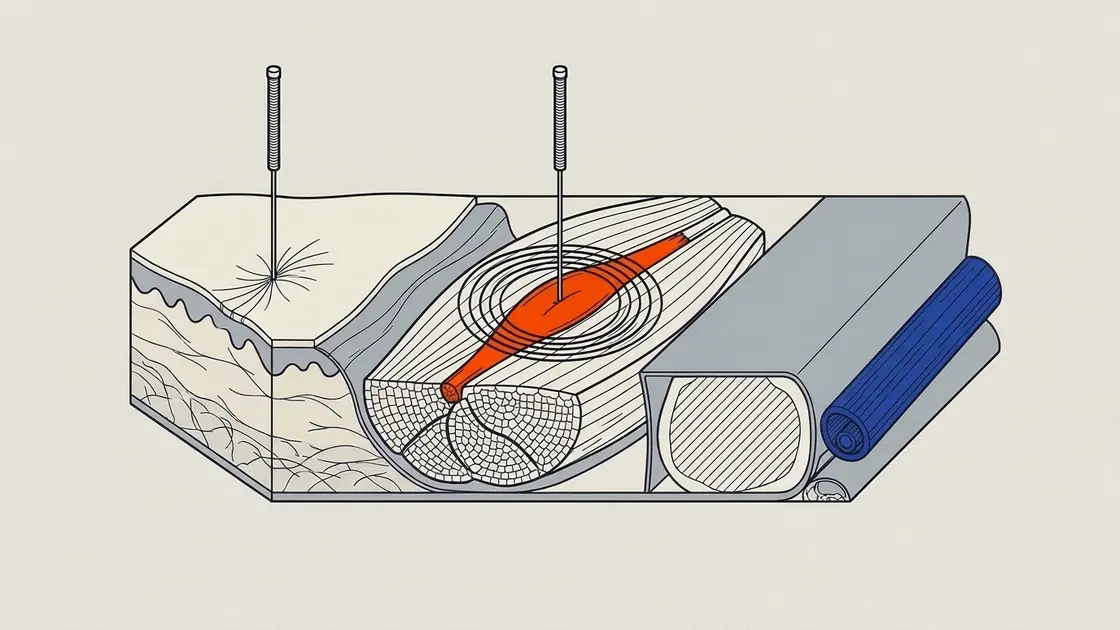
Dermal & fascial collagen coupling
A solid non-cutting filiform needle (0.25 mm rounded tip) enters via perpendicular insertion (90°), gently tenting loose areolar collagen fibers without slicing dermal vessels.
Myofascial spindle & Aδ / C transduction
Within the calibrated depth target window at EX-LE5, mechanical coupling recruits intramuscular mechanoreceptors, increasing local micro-perfusion and releasing taut bands.
Strict anatomical safety floor
The deep fascial septum, bone cortex, and underlying neurovascular bundle or cavity define the strict anatomical boundary observed during physician needling at EX-LE5.
Clinical trial protocols using this point
- studies cite this point
- 8 studies cite this point
- RCTs
- 1 RCTs
- sham-controlled
- 7 sham-controlled
Top clinical conditions tested
Most frequent synergistic partner points
EX-LE5 in research
How many Library studies cite this point, since when, and with which designs and verdicts.
- Studies
- 5Library studies cite EX-LE5
- By year
- 20162025
- Verdict
- Strong2
- Moderate2
- Limited1
- Study designs
- Meta-analysis3
- Systematic Review1
- RCT1
- Classical source
- Bei Ji Qian Jin Yao Fang
Each study counts once, under the most specific design it states. The verdict is the Library’s word for the strength of each study’s evidence.
See the numbers: EX-LE5 in research
| Year | Studies |
|---|---|
| 2016 | 1 |
| 2019 | 1 |
| 2021 | 1 |
| 2025 | 2 |
Often appears with
Points the Library studies cite together with EX-LE5. It shows research practice, not a prescription.
- ST 354 studies in common
- SP 94 studies in common
- SP 104 studies in common
- GB 344 studies in common
- ST 363 studies in common
- EX-LE42 studies in common
- LI 41 study in common
- ST 341 study in common
Each filled mark stands for 5 studies; an open mark, for 1 to 4.