Skip to content
Skip to content

ST-35 Dubi (犢鼻) — Calf's Nose

ST-35
Dubi
犢鼻
Calf's Nose
ST-35 Dubi — Calf's Nose
SafeMembro Inferior
Depth
00.7–1 cun3.0
Oblique insertion
Precautions
Strict aseptic technique must be observed, as the needle penetrates the joint space.
Location (classical)
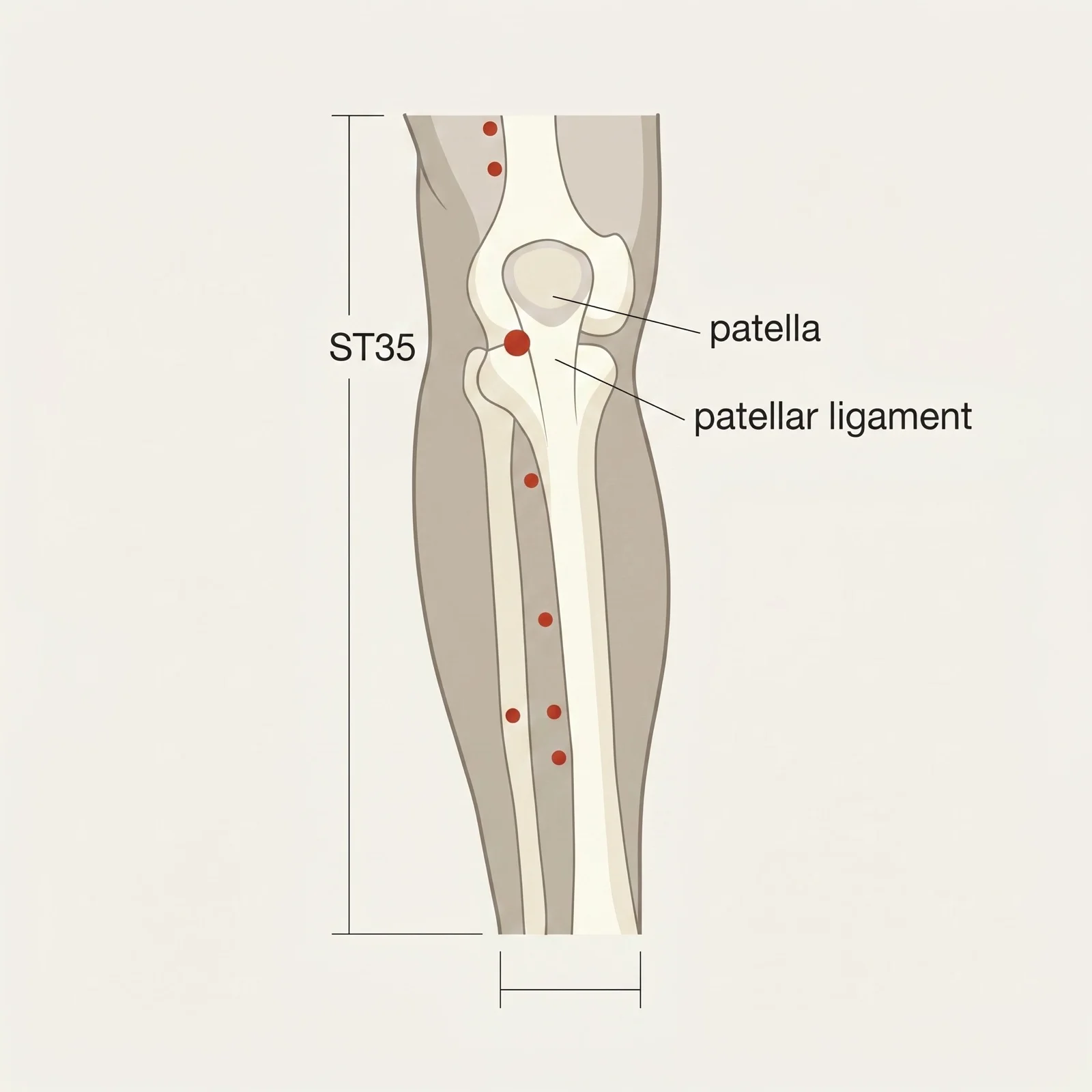
At the knee, in the cavity formed when the knee is flexed, immediately below the patella and lateral to the patellar ligament. (Also known as the lateral Xiyan point.)
How to find it (practical)
Seated, with the knee flexed, locate the point in the depression lateral to the patellar tendon, between the patella and the tibia.
Anatomy
Patellar ligament, lateral meniscus, knee joint capsule. Innervated by articular branches of the femoral and common fibular nerves.
Needling
Oblique insertion directed slightly medially and superiorly (behind the patellar ligament) 0.7–1.0 cun.
Etymology
Du (犊), calf; Bi (鼻), nose. The depressions below the patella are likened to a calf's nostrils. The point lies in the lateral foramen.
CLASSICAL SOURCELing Shu

Clinical Relations

Adjacent Points on the Meridian

ST 35 in research

How many Library studies cite this point, since when, and with which designs and verdicts.

Studies
14Library studies cite ST 35
By year
20122026
Verdict
  • Strong7
  • Moderate7
Study designs
  • Meta-analysis5
  • Systematic Review1
  • RCT4
  • Narrative Review1
  • Other designs3
Classical source
Ling Shu
Depth
0.7–1 cunOblique

Each study counts once, under the most specific design it states. The verdict is the Library’s word for the strength of each study’s evidence.

See the numbers: ST 35 in research
YearStudies
20121
20191
20203
20211
20231
20242
20254
20261

Often appears with

Points the Library studies cite together with ST 35. It shows research practice, not a prescription.

  1. GB 3412 studies in common
  2. SP 911 studies in common
  3. SP 1010 studies in common
  4. ST 368 studies in common
  5. ST 347 studies in common
  6. EX-LE46 studies in common
  7. EX-LE54 studies in common
  8. SP 63 studies in common

Each filled mark stands for 5 studies; an open mark, for 1 to 4.

Related Articles

3

Translation and clinical dataProf. Dr. Hong Jin Pai — Meridians: Theory and Clinical Practice, 4th edition. CEIMEC · São Paulo.

CodingWHO Standard Acupuncture Point Locations (2008) for classical and extra points.