Skip to content
Skip to content

ST-7 Xiaguan (下關) — Below the Joint

ST-7
Xiaguan
下關
Below the Joint
ST-7 Xiaguan — Below the Joint
Encontro com VBSafeCabeça
Depth
00.2–0.4 cun3.0
Perpendicular insertion
Precautions
Deep needling reaches the lateral pterygoid muscle. Some classical texts contraindicate moxibustion.
Location (classical)
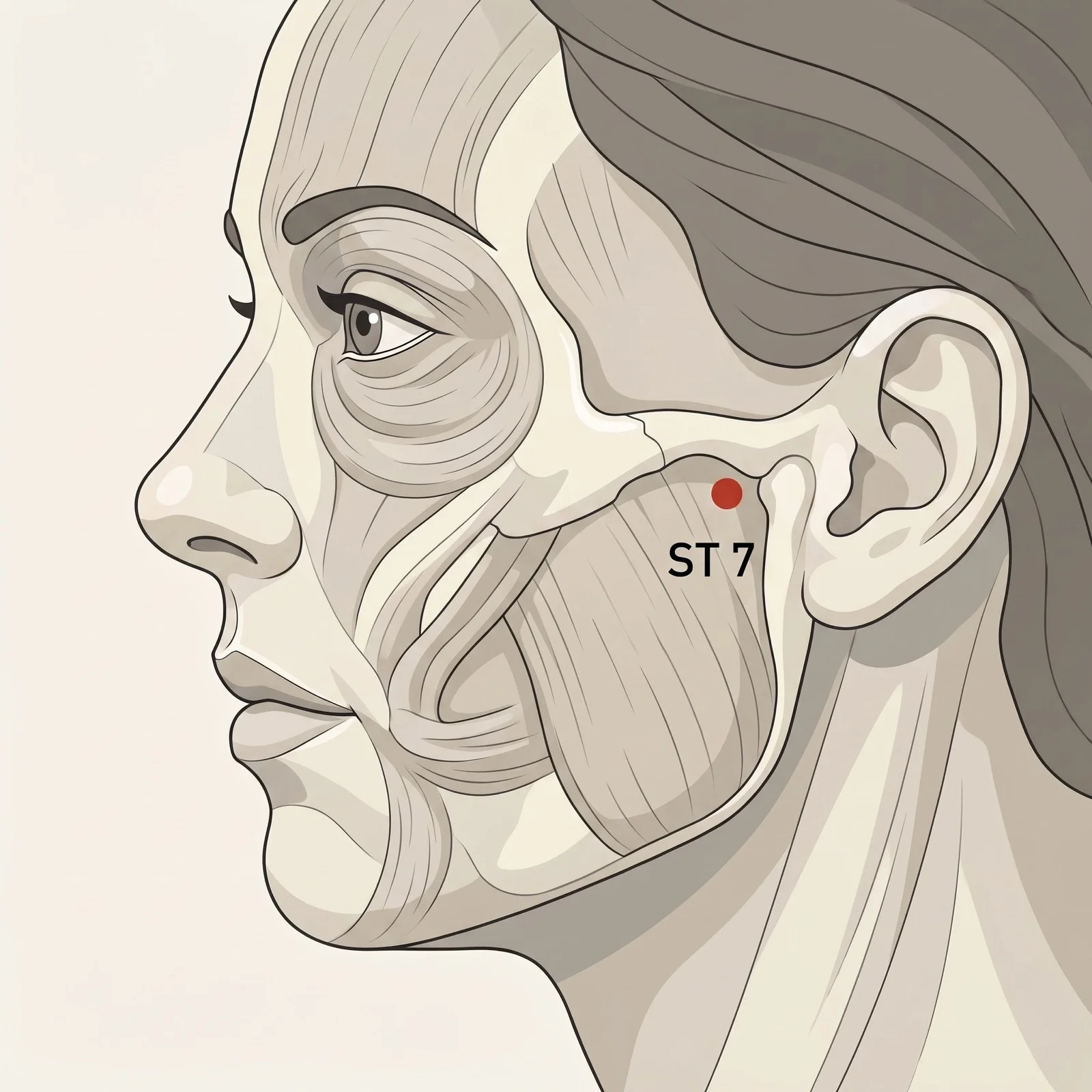
On the face, in the depression between the middle of the inferior border of the zygomatic arch and the notch of the mandible.
How to find it (practical)
Seated or in lateral decubitus, with the mouth closed, locate the point in the depression below the zygomatic arch. The depression becomes more pronounced when the mouth is opened.
Anatomy
Masseter and lateral pterygoid muscles. Branches of the facial nerve and the mandibular nerve. Superficial temporal artery in the vicinity.
Needling
Perpendicular insertion 0.2–0.4 cun.
Etymology
Xia (下), below; Guan (关), passage, joint. Guan refers to the zygomatic arch: the point lies below the zygomatic arch.
CLASSICAL SOURCELing Shu

Clinical Relations

Adjacent Points on the Meridian

ST 7 in research

How many Library studies cite this point, since when, and with which designs and verdicts.

Studies
11Library studies cite ST 7
By year
20102024
Verdict
  • Strong4
  • Moderate6
  • Weak1
Study designs
  • Meta-analysis1
  • Systematic Review1
  • RCT6
  • Case Series2
  • Other designs1
Classical source
Ling Shu
Depth
0.2–0.4 cunPerpendicular

Each study counts once, under the most specific design it states. The verdict is the Library’s word for the strength of each study’s evidence.

See the numbers: ST 7 in research
YearStudies
20101
20132
20141
20151
20181
20202
20211
20242

Often appears with

Points the Library studies cite together with ST 7. It shows research practice, not a prescription.

  1. ST 610 studies in common
  2. LI 49 studies in common
  3. ST 44 studies in common
  4. SI 183 studies in common
  5. SI 193 studies in common
  6. GB 143 studies in common
  7. ST 52 studies in common
  8. ST 82 studies in common

Each filled mark stands for 5 studies; an open mark, for 1 to 4.

Related Articles

5

Translation and clinical dataProf. Dr. Hong Jin Pai — Meridians: Theory and Clinical Practice, 4th edition. CEIMEC · São Paulo.

CodingWHO Standard Acupuncture Point Locations (2008) for classical and extra points.