Skip to content
Skip to content

BL-58 Feiyang (飛陽) — Soaring Upward

BL-58
Feiyang
飛陽
Soaring Upward · Soaring Upwards
BL-58 Feiyang — Soaring Upward
Ponto Luo de ConexãoSafeMembro Inferior
Depth
00.7–1 cun3.0
Perpendicular insertion
Precautions
No standard contraindications.
Location (classical)
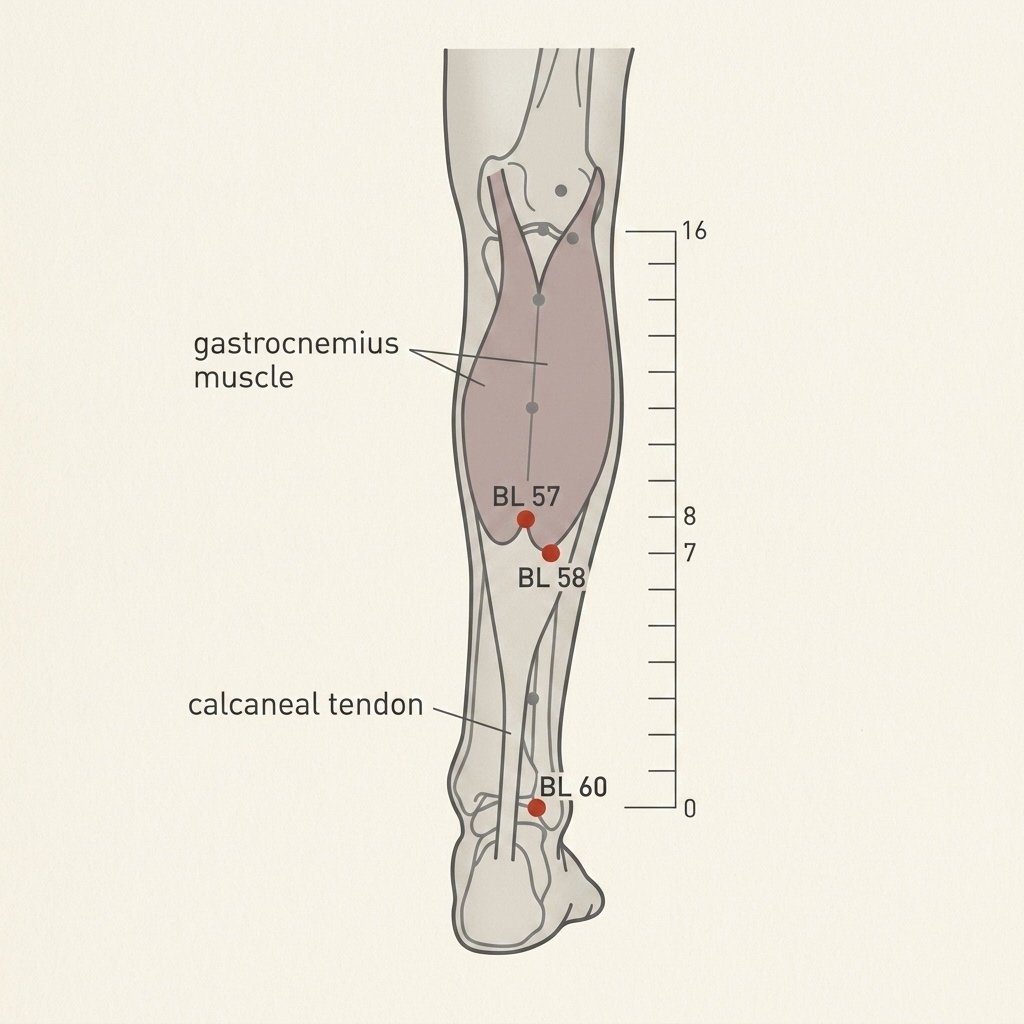
On the posterior aspect of the leg, 7 cun directly superior to BL-60, 1 cun inferior and lateral to BL-57.
How to find it (practical)
Seated with the ankle in plantar flexion, locate the point 1 cun obliquely and inferior to Cheng Shan (BL-57), immediately above Kun Lun (BL-60).
Anatomy
Gastrocnemius and soleus muscles. Innervated by the sural nerve.
Needling
Perpendicular insertion, 0.7–1.0 cun.
Etymology
Fei (飞), to fly; Yang (扬), to lift. It signifies that the collateral of the Bladder Meridian, Foot Tai Yang, emerges from this point toward the Kidney Meridian, Foot Shao Yin.
CLASSICAL SOURCELing Shu

Clinical Relations

Point Pairs
Yuan-LuoKI-3 Taixi
Adjacent Points on the Meridian

BL 58 in research

How many Library studies cite this point, since when, and with which designs and verdicts.

Studies
2Library studies cite BL 58
By year
20212024
Verdict
  • Strong1
  • Moderate1
Study designs
  • RCT1
  • Narrative Review1
Classical source
Ling Shu
Depth
0.7–1 cunPerpendicular

Each study counts once, under the most specific design it states. The verdict is the Library’s word for the strength of each study’s evidence.

See the numbers: BL 58 in research
YearStudies
20211
20241

Often appears with

Points the Library studies cite together with BL 58. It shows research practice, not a prescription.

  1. ST 361 study in common
  2. HT 31 study in common
  3. SI 31 study in common
  4. BL 231 study in common
  5. BL 241 study in common
  6. BL 251 study in common
  7. BL 301 study in common
  8. BL 401 study in common

Each filled mark stands for 5 studies; an open mark, for 1 to 4.

Related Articles

6

Translation and clinical dataProf. Dr. Hong Jin Pai — Meridians: Theory and Clinical Practice, 4th edition. CEIMEC · São Paulo.

CodingWHO Standard Acupuncture Point Locations (2008) for classical and extra points.