Skip to content
Skip to content

BL-17 Geshu (膈俞) — Diaphragm Shu

BL-17
Geshu
膈俞
Diaphragm Shu
BL-17 Geshu — Diaphragm Shu
★ MajorPonto Hui-Reunião do SanguePonto Shu do DiafragmaPonto Hui-Reunião do SangueDangerTórax
Depth
00.5 cun3.0
Oblique insertion
Precautions
High risk of pneumothorax.
Location (classical)
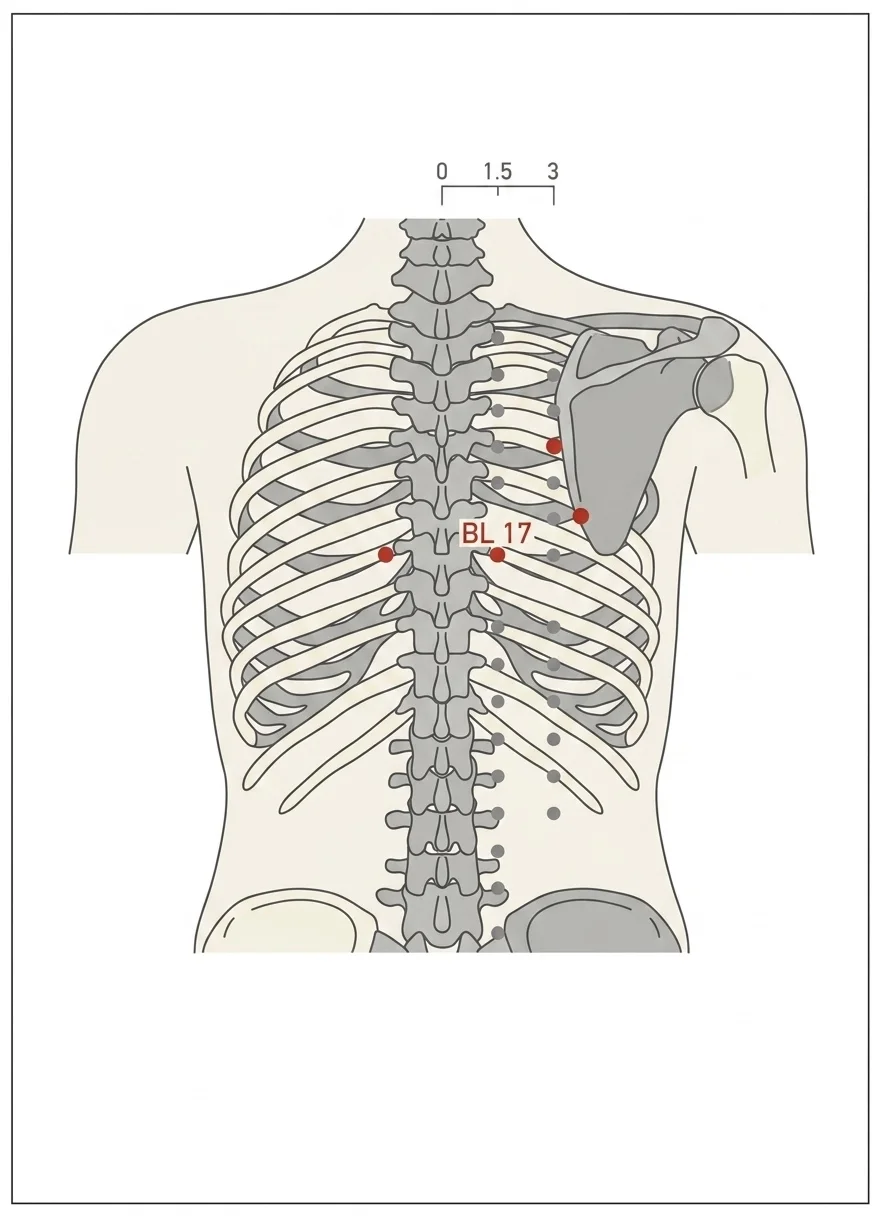
On the back, 1.5 cun lateral to the inferior border of the spinous process of the seventh thoracic vertebra (T7). At the level of the inferior angle of the scapula.
How to find it (practical)
In ventral or lateral decubitus, locate the point below the spinous process of the seventh thoracic vertebra, 1.5 cun lateral to Zhi Yang (GV-9), at the level of the infrascapular margin.
Anatomy
Trapezius, latissimus dorsi, and erector spinae muscles.
Needling
Oblique insertion toward the spine, 0.5 cun.
Etymology
Ge (膈), diaphragm; Shu (俞), point. Place where the Qi of the Ge (diaphragm) reaches the back.
CLASSICAL SOURCELing Shu

Clinical Relations

Adjacent Points on the Meridian

BL 17 in research

How many Library studies cite this point, since when, and with which designs and verdicts.

Studies
2Library studies cite BL 17
By year
20102023
Verdict
  • Moderate2
Study designs
  • RCT1
  • Case Series1
Classical source
Ling Shu
Depth
0.5 cunOblique

Each study counts once, under the most specific design it states. The verdict is the Library’s word for the strength of each study’s evidence.

See the numbers: BL 17 in research
YearStudies
20101
20231

Often appears with

Points the Library studies cite together with BL 17. It shows research practice, not a prescription.

  1. ST 362 studies in common
  2. BL 202 studies in common
  3. PC 62 studies in common
  4. CV 122 studies in common
  5. BL 181 study in common
  6. BL 211 study in common
  7. LR 141 study in common
  8. GV 141 study in common

Each filled mark stands for 5 studies; an open mark, for 1 to 4.

Related Articles

6

Translation and clinical dataProf. Dr. Hong Jin Pai — Meridians: Theory and Clinical Practice, 4th edition. CEIMEC · São Paulo.

CodingWHO Standard Acupuncture Point Locations (2008) for classical and extra points.