GB-6 Xuanli (懸厘) — Suspended Tuft
Anatomical location
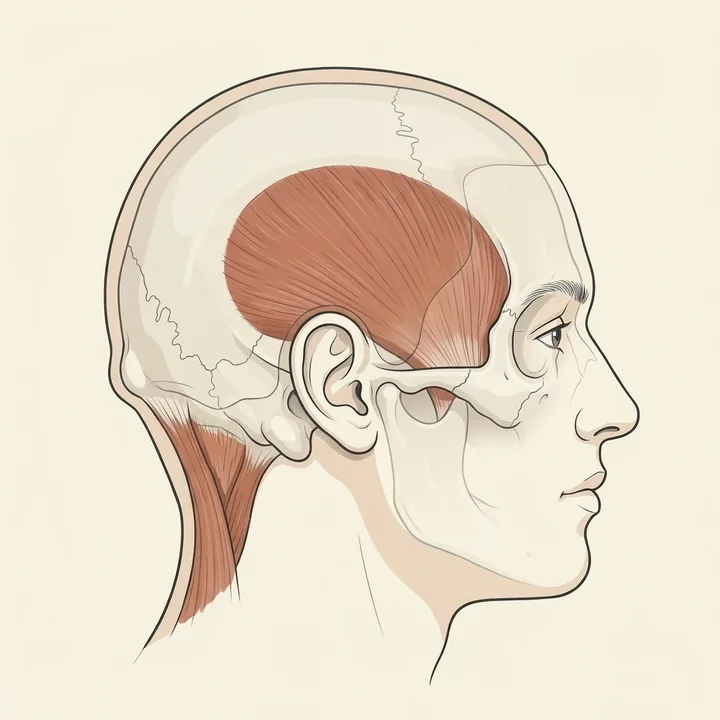
On the lateral aspect of the head, within the hairline, at the junction of the lower one-quarter and upper three-quarters of the curved line connecting ST-8 and GB-7.
Practical palpation guide
Seated with the head at rest or in lateral decubitus. Locate the point at the junction of the upper three-quarters and the lower one-quarter of the curved line that connects Tou Wei (ST-8) and Qu Bin (GB-7), or at the midpoint of the distance between Xuan Lu (GB-5) and Qu Bin (GB-7).
Anatomical plane & innervation
Temporalis muscle. Innervated by the auriculotemporal nerve.
Needling technique
Oblique insertion directed posteriorly, 0.5 to 0.8 cun.
Medical application & myofascial correlation
Clinical synthesis
It is a Crossing point with the Stomach Meridian, Foot Yang Ming, which has the function of regulating the Wei (Stomach) and the Pi (Spleen). According to the principle that a point treats disorders of the interconnected meridians, this point may be indicated for treating fever and disorders of the digestive system. The point has the function of eliminating pathogenic wind and heat and activating the flow of Qi in the collaterals to relieve pain; therefore, it may be used in the treatment of disorders of the head, face, sense organs, and convulsions. See Han Yan (GB-4) for further details.
Clinical practice indications
- 01Migraine
- 02Neurasthenia
- 03Tension in the temporalis muscle
Presenting symptoms & complaints
Classical tradition, channel actions & source
Classical therapeutic actions
- Eliminates Wind
- Clears Heat
- Relieves pain
Traditional indications (TCM)
Character etymology
Xuan (悬), to suspend; Li (厘), to arrange, to correct. The point is located on the temple and has the function of relieving headache and improving dizziness.
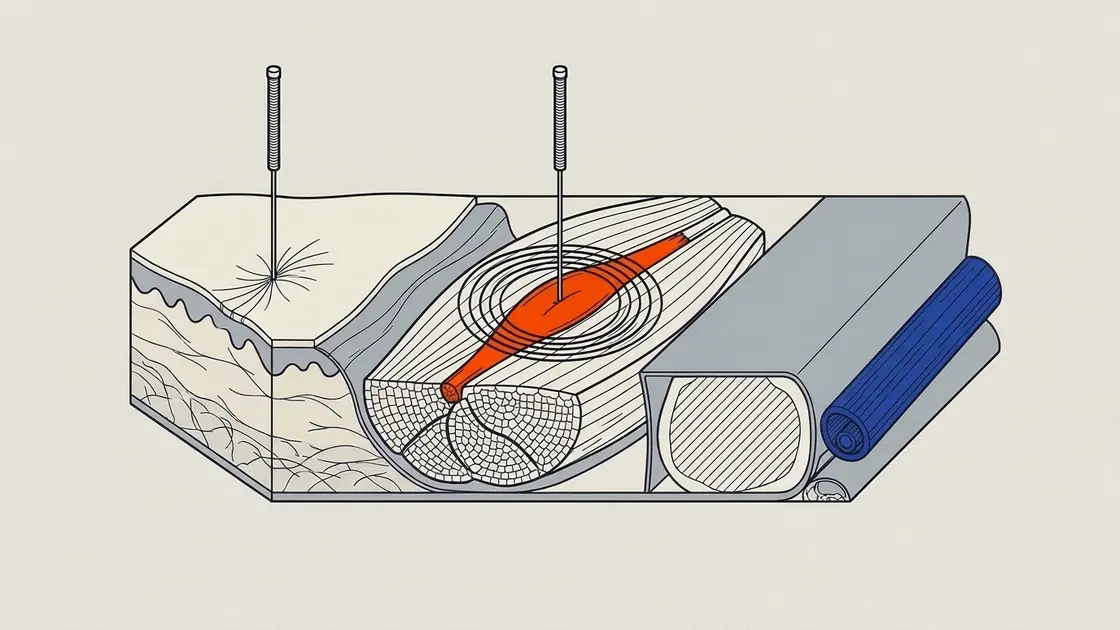
Layered tissue anatomy & needle biomechanics at GB 6
Cross-sectional technical schematic of oblique insertion (~45°) (0.5–0.8 cun): superficial connective collagen coupling, intramuscular myofascial transduction, and deep neurovascular protection.
Dermal & fascial collagen coupling
A solid non-cutting filiform needle (0.25 mm rounded tip) enters via oblique insertion (~45°), gently tenting loose areolar collagen fibers without slicing dermal vessels.
Myofascial spindle & Aδ / C transduction
Within the 0.5–0.8 cun target window at GB 6, mechanical coupling recruits intramuscular mechanoreceptors, increasing local micro-perfusion and releasing taut bands.
Deep neurovascular clearance
Calibrated angle and depth keep the needle tip clear of periosteum and deep neurovascular trunks, pairing targeted stimulation with anatomical safety.
Clinical relations & channel protocols
Immediate neighbors on the meridian
GB 6 in research
How many Library studies cite this point, since when, and with which designs and verdicts.
- Studies
- 1Library study cites GB 6
- By year
- 2024
- Verdict
- Moderate1
- Study designs
- Meta-analysis1
- Classical source
- Jia Yi Jing
- Depth
- 0.5–0.8 cunOblique
Each study counts once, under the most specific design it states. The verdict is the Library’s word for the strength of each study’s evidence.
See the numbers: GB 6 in research
| Year | Studies |
|---|---|
| 2024 | 1 |
Often appears with
Points the Library studies cite together with GB 6. It shows research practice, not a prescription.
- ST 361 study in common
- SP 61 study in common
- GB 81 study in common
- GB 91 study in common
- GB 131 study in common
- LR 31 study in common
- EX-HN11 study in common
Each filled mark stands for 5 studies; an open mark, for 1 to 4.
Related clinical reading
3Understand tension-type headache — the most common headache, its mechanisms, how to tell it apart from migraine, and the most effective therapeutic approaches.
Understand migraine — a complex neurological disease that goes far beyond a simple headache, its mechanisms, diagnosis, and evidence-based treatments.
Understand tinnitus — the perception of sounds in the absence of an external stimulus, its neurophysiologic mechanisms, causes, and evidence-based therapeutic approaches.